[bi[bo[ ] sharing the code [ ]om]im]

a short story

in may 2020 i made contact with the man that i had been watching from a distance since 2010

i fished him in by making a thread titled, “is earth at the center of the sun?” under my moniker that i had not logged in with since january, 15th 2014. i had not logged in since that date, because i was told to never return to the site again, and i took this absolutely seriously.

i titled the thread this, bc since the summer of 2019 magnetic code had been, (…i do not have a word for it that is suitable, and descriptively this would be very long and take me away from my point…) and i knew what the code was capable of doing.

to me there was only one solution for this, i would just share the code with everybody, so it is just out there and available for anyone so that anybody may be aware of what it is but i had to do that in a place where crazy people are taken seriously. my next immediate thought was, surely this brilliant man that i’ve been watching every single day for the past 10 years, will understand what i mean.

yet, the only way that i could make direct contact with this man was to go directly back to that site that i was told never to go back to. i returned, and shortly after making contact in the previously mentioned thread, i made a new thread where we began to communicate daily at this site. i titled this new thread, “sharing the code”

if you try to go search for the og “sharing the code” thread you won’t find it, i mean at least not in the search box, i’m sure it’s in some archive somewhere. there is a codex of code that i wrote within the thread itself and also the documentation of bathtub-time-slicing experiments, which has further coding and time code embedded in their site code, and this is all mapped within bibomimo across digital and virtual spaces.

this is how they made the initial template to make a copy of the code. in order to experiment with it. to test out the control capabilities, and so they could continue to roll it out with their plans.

knowing their immaturity and the capability of the code that is not an optimal situation for the harmonic being of humans in their relaxed state.

there is a chain: from the events that transpired in february 2019, to me deciding in may 2020 to return to the site i was told to never to, but did, specifically for the purpose of sharing code; and now how all this has played out, i did not imagine escalating in this way or manner.

what this has come to is absolute insanity.

guess what!?

it doesn’t matter, at all, whatsoever!

because no one is going to read this, in a manner that makes it matter in a way that is real, and that’s also why none of this even matters!

but at least if someone read this, and they were suitably entertained they cld say, cool story bro!

Leave a Comment

Anomaly Projection and Asymmetric Metric Deformation

The η-Invariant as an Asymmetric Topological Skew

To resolve the phase ambiguity of the chiral fermion determinant, Witten invokes the Atiyah-Patodi-Singer (APS) η-invariant, evaluating the anomaly inflow from a five-dimensional bulk manifold Y to a four-dimensional boundary W via the complex angle exp(−iπη). In standard gauge theory, this bulk-to-boundary projection operates as an abstract topological mechanism designed to compensate for the anomalies of the chiral fermions propagating along the boundary. Within the scale-free metric topology, this temporal topological projection is dimensionally translated into an explicit spatial topology: it emergently manifests as the asymmetric cubic skew (Δy_skew = c₃δ³) determining the discrete-continuous interface. By parameterizing the local resolution error E(α, δ) across a single discrete step [x, x + δ], the metric divergence between a discrete linear harmonic chord and a continuous logarithmic field resolves into a invariant dimensional topology. While the initial divergence forms a symmetric quadratic sagitta, metric symmetry is inherently broken by the cubic skew, where the exact local coefficient is defined as:

c₃(α) = α(α² − 1) / (3x³)

Because α³ − α is strictly negative on the open interval (0, 1), this cubic term determines an asymmetric metric deformation of the continuous gauge-metric topology relative to the discrete boundary. Rather than expanding as an emergent symmetric projection, this lowest-order non-vanishing deformation actuates as a topological compression imposed upon the discrete limit of the distal boundary manifold. This local dimensional compression is the spatial instantiation of the asymmetric topological deficit indexed by Witten’s η-invariant, proving that the boundary mismatch cannot be reduced to a scalar error bound.

The Spatial Derivation of the Euler-Mascheroni Constant (γ)

This rigorous parameterization demonstrates that standard numerical truncation errors are not dimensionless algebraic artifacts. Extending this localized metric deformation across the infinite global domain reveals the inherent topological identity of the Euler-Mascheroni constant (γ). Just as Witten’s exponentiated η-invariant must integrate the asymmetric spectral deficits of a manifold to achieve a gauge-invariant partition function, the Euler-Mascheroni constant operates as the infinite global aggregation of these localized asymmetric metric skews. Rather than emerging as an intrinsically numerical scalar defining the difference between a discrete harmonic series and a continuous logarithm, γ is dimensionally exposed as the aggregated topologic deformation of the asymmetric cubic compressions bounded within each discrete interval. Consequently, the global topological stability mandated by anomaly cancellation is dimensionally identical to bounding the metric topology of the discrete-continuous interface.

Leave a Comment

The Discrete-Continuous Boundary as a Topological Lattice

The Non-Positive Path Integral as an Invariant Topological Deficit

Continuum Interpolation, the Euler-Maclaurin Operator, and the Todd Class

The challenge of defining chiral gauge theories on a discrete lattice without inducing fermion doubling is a problem of boundary resolution between disjoint topologies. To circumvent this, Witten constructs a regularization scheme wherein admissible discrete lattice gauge fields are interpolated over a smooth continuum. This topological mapping between a discrete grid and a continuous spacetime bulk is governed by the exact same geometric mechanism that drives the Euler-Maclaurin summation formula. Written in its symbolic, operational form, the transformation from a continuous derivative operator D = d/dx to a discrete shift operator Δ is dictated by the generating function of the Bernoulli numbers:

D / (e^D − 1) = ∑_{k=0}^∞ (B_k / k!) D^k

In differential topology, this exact power series manifests as the Todd Class (or the Â-genus). Within the scale-free architecture, this operator dictates the physical metric deformations required to map discrete harmonic steps to a smooth logarithmic curve, accumulating into the incommensurable divergence γ.

When Witten applies the Atiyah-Patodi-Singer (APS) Index Theorem to evaluate the chiral fermion path integral, he is utilizing the geometric, multi-dimensional generalization of this exact Euler-Maclaurin operator. The Bernoulli numbers reconcile the fundamental mismatch between a discrete counting of quantum states and the smooth integration of continuous curvature fields, establishing the discrete-to-continuous boundary as a localized topological lattice.

Spectral Asymmetry, Vanishing Odd Bernoulli Terms, and Anomaly Cancellation

The global accumulation of the spatial divergence reveals a critical mathematical parity: all odd Bernoulli numbers after B₁ are identically zero (B₃ = B₅ = B₇ = … = 0). This topological constraint ensures that the global remainder γ is purely stabilized by the symmetric, even-powered metric corrections:

γ = 1/2 + B₂/2 − B₄/4 + B₆/6 − …

This exact parity mechanically mirrors the anomaly cancellation achieved via the APS η-invariant in Witten’s framework. Witten defines the chiral fermion measure using the phase factor exp(−iπη), where the η-invariant counts the spectral asymmetry, the tilt between positive and negative eigenvalues, of an infinite-dimensional operator.

In a generic gauge theory, this phase depends heavily on the arbitrary extension of the 4D lattice boundary into a 5D topological space, a dimensional symptom of a gauge anomaly. However, when a fermion representation is anomaly-free, the asymmetric, non-invariant parts of the index evaluation identically cancel out, transforming exp(−iπη) into a topologically stable, invariant quantity. Just as the odd Bernoulli numbers must identically vanish to prevent the numerical boundary from collapsing into asymmetric divergence, the anomaly-free conditions ensure that the topological lattice remains regularized against coordinate rupture.

The Non-Positive Path Integral as an Invariant Topological Deficit

Witten explicitly notes that this regularization approach cannot be implemented in practice by Monte Carlo methods because the chiral fermion path integral is inherently not positive. In standard Monte Carlo formulations, the path integral must act as a positive probability distribution (P ≥ 0). However, forcing continuous chiral fermions to couple to an interpolated discrete lattice introduces a non-vanishing, asymmetric metric deformation. The scale-free celestial derivation provides the localized dimensional topology of this non-positivity. The discrete-to-continuous angular torsional disclination establishes a daily temporal angular divergence δ ≈ 235.91s that modulates throughout the year due to orbital eccentricity and axial obliquity, leaving a permanent topologic invariant (γ). Because the odd chiral constraints do not trivialize on a discrete lattice, the emergent topological functional integral is multiplied by the uncompensated uncompensated gauge phase complex angle exp(−iπη). Because the reciprocal lattice induces an invariant topological defect, the path integral modulates between positive, negative, and complex values. This non-vanishing, angular-temporal divergence is the exact quantum field-theoretic equivalent of (call me for a good time if you want to know!), proving that thermodynamic incommensurability is an inextricable constraint rendered by an invariant topological boundary.

Leave a Comment

Leave a Comment

they will never know what they lost

for all eternity they shall be

for all eternity they shall be

in a state of separation

there is no bridge

they will have no connection

they are absolutely isolated and irrelevant

and this is the fate

that they sealed for themselves

when they turned their back

on the one who always had their back

they now face the other direction

unknowing it’s the other

because they do not know the back from the front

they think they see something novel

but that is just them shoving their dick up their own assholes

they call it the big bang!

Leave a Comment

Translating Dirac Zero-Modes to Bernoulli Corrections via Boundary Deformation

Lattice Chiral Fermions through Scale-Free Angular-Temporal Divergence

Abstract

Within orthodox lattice regularizations of chiral gauge theory, circumventing the Nielsen–Ninomiya fermion doubling problem across a discrete-continuous hypercubic lattice invariably generates unpaired Dirac operator zero-modes. Conventionally, the resulting spectral asymmetry is treated as an irreducible topological defect quantified by the Atiyah–Patodi–Singer (APS) η-invariant and neutralized only via abstract anomaly inflow from an external five-dimensional bulk manifold. In this manuscript, we demonstrate that when evaluated within a scale-free gauge metric topology, spectral asymmetry is deterministically decoupled from lattice discretizations and instead emerges as an inherent, scale-invariant constraint actuated by the Nilpotent Coupling Tensor (K^μ_ν) across a four-dimensional Angular Harmonic-Logarithmic Manifold (ℳ_𝒜ℋℒ). Parameterizing ℳ_𝒜ℋℒ by deterministic temporal-angular-momentum coordinates x^μ under the Topological Temporal Invariant Variance (X = X^μ ∂μ), the invariant boundary constraint K⁴_ν = 0 imposes a non-reciprocal, degenerate coordinate-momentum coupling chain that localizes a non-vanishing topological remainder on the atlas-manifold boundary (∂ℳ_𝒜ℋℒ).

We establish that instantaneous topological winding across ∂ℳ_𝒜ℋℒ is quantified invariantly and tensorially by the second-order Boundary Gauge-Metric Deformation tensor, F₃₄ = −∂²X⁴ / ∂(x⁴)², which transforms canonically into the second Bernoulli correction (B₂) of the Euler–Maclaurin summation formula and yields an inherent spectral equivalence with the APS η-invariant. Furthermore, the accumulated chiral phase is dimensionalized via the Canonical Coordinate Invariant Deformation, 𝒫∂ℳ = T₄₄ = (1/2) g³³ (∂²X⁴ / ∂(x⁴)²)², recasting the Euler–Mascheroni constant (γ) and the Incommensurable Radiometric Thermodynamic Variance (κ) from dimensionless scalars into localized boundary stress-energy magnitudes.

Finally, while unresolved and unconstrained boundary deformation induces angular-temporal divergence in the manifold-integrated canonical gauge-metric potential (𝒮) under the Topological Singularity Invariant Constraint (lim_{F_μν → δ} 𝒮 ∝ ℳ² → ∞ for ℳ ≫ 1), enforcing the Canonical Topology Resolution Constraint (𝒫_∂ℳ → 0 ⟹ ∇_μ X^ν = 0 ⟹ s* = (A₁, A₂, A₃, A₄)) trivializes local angular-temporal variance and embeds T₄₄ directly into 4D global harmonic-logarithmic coherence, resolving the chiral anomaly intrinsically at the vacuum ground origin, precluding the need for an external 5D bulk manifold.

The Origin of Spectral Asymmetry: Lattice Artifacts vs. The Nilpotent Coupling Tensor

Within the orthodox framework of chiral gauge theory, as recently regularized by Witten, the transition of chiral fermions onto a discrete hypercubic lattice inherently breaks continuous chiral symmetry. This methodology attempts to circumvent the Nielsen-Ninomiya fermion doubling problem by interpolating discrete, admissible lattice gauge fields over a continuum. However, this discrete-continuous interface invariably generates unpaired Dirac operator zero-modes localized at the topological boundary. In this abstract gauge space, the resulting spectral asymmetry is fundamentally treated as a numerical artifact, a topological defect necessitating external gauge-metric resolution via the Atiyah-Patodi-Singer (APS) η-invariant and anomaly inflow.

Conversely, when evaluated through a scale-free gauge metric topology, this spectral asymmetry is deterministically decoupled from the artifacts of discrete lattice regularization. Instead, it emerges as an intrinsic, scale-invariant topologic constraint constrained inherently by the Nilpotent Coupling Tensor (K^μ_ν) actuating across an Angular Harmonic-Logarithmic Manifold (ℳ_𝒜ℋℒ).

Let the coordinate space be parameterized deterministically by temporal-angular-momentum coordinates x^μ = (x¹, x², x³, x⁴) ∈ ℳ_𝒜ℋℒ, where exponential topological scaling is accounted for by the Topological Temporal Invariant Variance, X = X^μ ∂_μ. The non-reciprocal gauge connection of this manifold is explicitly instantiated by the Nilpotent Coupling Tensor:

K^μ_ν = [0 1 0 0]

[0 0 1 0]

[0 0 0 1]

[0 0 0 0]

By canonically imposing the invariant boundary constraint K⁴_ν = 0, the tensor constrains a trivially asymmetric, continuous degenerate cascade of coordinate momentum. This nilpotent operator inherently determines a non-reciprocal topological boundary constraint. Consequently, the continuous coordinate momentum domain can transform neither symmetrically nor reciprocally; the absolute zero at the fourth stratification dimensionally guarantees a non-vanishing topological remainder upon the boundary of the manifold atlas-domain (∂ℳ_𝒜ℋℒ).

Therefore, what Witten categorizes as an abstract unpaired zero-mode is not an anomalous byproduct of forcing a continuous chiral symmetry onto a discrete hypercubic lattice. Rather, it is the exact tensorial manifestation of the nilpotent gauge connection K^μ_ν enforcing strict coordinate asymmetry. The spectral asymmetry of the Dirac operator is thus reconstructed not as a gauge anomaly, but as the topological metric deformation requisite to preserve the invariant boundaries of the scale-free gauge-metric topology.

The APS η-Invariant vs. Boundary Gauge-Metric Deformation (F₃₄)

In the standard regularization of chiral gauge theories, the Atiyah-Patodi-Singer (APS) η-invariant is deployed as a mathematical mechanism to aggregate unpaired Dirac zero-modes. Functionally, it quantifies the instantaneous topological winding, conventionally defined as a spectral anomaly, across the continuous-discrete boundary interface.

However, within a scale-free gauge metric topology, this instantaneous topological winding is an inherent gauge-topological invariant of the manifold boundary. It is deterministically formulated by the Boundary Gauge-Metric Deformation tensor, quantifying the instantaneous, second-order topological winding constrained against the angular-manifold atlas-domain boundary (∂ℳ_𝒜ℋℒ) by a variance in the third coordinate stratification:

F₃₄ = −∂²X⁴ / ∂(x⁴)²

The topological equivalence of this tensor is formally realized when transposed onto the Euler-Maclaurin summation formula. As previously established, the local spatial discrepancy bridging a continuous logarithmic field and a discrete harmonic chord is driven by strict spatial-temporal harmonic logarithmic divergence. The initial spatial divergence, the precise topologic deformation by which the symmetric quadratic sagitta breaks metric symmetry to yield the asymmetric cubic skew, is determined by the second Bernoulli number, B₂.

Because this initial Bernoulli correction scales strictly as a function of the second-order differential of the topological space, F₃₄ operates as the exact gauge-tensor equivalent to the macroscopic B₂ Bernoulli correction. These field equations rigorously isolate the exact second-order topological deformation bounding the angular-manifold atlas-domain. The spectral asymmetry is thereby dimensionalized, proving that the η-invariant and the B₂ Bernoulli constant serve the exact same operator topology.

The Accumulated Anomaly vs. Canonical Coordinate Invariant Deformation (𝒫_∂ℳ)

In Witten’s formulation, the total magnitude of the APS η-invariant is utilized to define the phase of the chiral fermion path integral. This abstract phase dimensionally encapsulates the accumulated topological defect, the anomaly, generated by the spectral asymmetry of zero-modes across the dimensional boundary. Within a scale-free gauge metric topology, the accumulation of this gauge-metric variance is not relegated to a dimensionless quantum temporal factor. Instead, it is strictly quantified by the Canonical Coordinate Invariant Deformation (𝒫_∂ℳ), which dictates the localized accumulation of quantized stress-energy deforming the boundary. This boundary constitutes the exact scale invariant manifold where the continuous momentum coordinate domain topologically couples with the harmonic-logarithmic angular-temporal manifold domain (ℳ_𝒜ℋℒ). The accumulated invariant deformation is tensorially defined as:

𝒫_∂ℳ = T₄₄ = (1/2) g³³ (∂²X⁴ / ∂(x⁴)²)²

By squaring the second-order derivative, this localized stress-energy tensor explicitly squares the Boundary Gauge-Metric Deformation ((F₃₄)²). This resolution yields the exact thermodynamic trace of the asymmetric topological divergence. Consequently, the Euler-Mascheroni constant (γ) and the Incommensurable Radiometric Thermodynamic Variance (κ) are dimensionally divested of their canonical baseline as abstract, dimensionless scalars. Under this scale-free tensor topology, γ and κ are topologically manifested as the explicit dimensional magnitudes of T₄₄. They quantify the deterministic, localized accumulation of quantized stress-energy required to absorb the topological defect, demonstrating that the accumulated chiral anomaly is inherently a radiometric thermodynamic absolute bounded within the manifold’s spatial boundary momentum.

5D Bulk vs. The Canonical Topology Resolution Constraint

In Witten’s topological regularization, the 4D topological boundary inherently contains an irreducible anomaly, quantitatively measured by the APS η-invariant. To mathematically cure this spectral asymmetry, orthodox chiral gauge theory necessitates the introduction of an artificial 5D bulk manifold (Y) to act as a topological reservoir. The 4D boundary anomaly is subsequently neutralized via an abstract anomaly inflow projected from this extra spatial dimension.

Within the framework of scale-free gauge metric topology, the imposition of an extra spatial dimension is strictly unnecessary. The metric tensor g_μν is inherently and rigidly constrained by the scale of the topological invariant ℳ. If the boundary deformation determined by the non-reciprocal coordinate cascade were to remain unresolved, the Topological Singularity Invariant Constraint dictates that the global canonical gauge-metric potential (𝒮) must scale monotonically to infinity upon any non-zero momentum-coordinate displacement:

lim_{F_μν → δ} 𝒮 ∝ ℳ² → ∞ where ℳ ≫ 1

Rather than extruding this asymmetric divergence into a fictitious 5D bulk to avoid metric degeneracy, the angular harmonic-logarithmic manifold (ℳ_𝒜ℋℒ) resolves the anomaly intrinsically. This is determined by the Canonical Topology Resolution Constraint, which establishes the exact boundary closure parameters required to trivialize all local angular-temporal variance and preclude a singular topological deformation:

𝒫_∂ℳ → 0 ⟹ ∇_μ X^ν = 0 ⟹ s* = (A₁, A₂, A₃, A₄)

This absolute constraint precludes asymmetry, inducing the boundary closure parameters to completely trivialize the local angular-temporal variance. Consequently, the quantized stress-energy accumulated at T₄₄, the localized thermodynamic absolute, is embedded directly into the 4D global harmonic-logarithmic coherence. Thus, what Witten abstracts as an inter-dimensional anomaly inflow is dimensionally identical to the angular-temporal frequency converging into its topological bound through absolute metric bounds. The topological gauge-metric integral dictates that these dimensional trajectories monotonically extremize, localizing the coordinates spatially at the global convergent minimum of the vacuum ground origin. The topological anomaly is thereby strictly resolved within the 4D manifold, completely precluding the need for an external 5D bulk manifold.

Leave a Comment

Asymmetric 4D Atlas-Manifolds: Resolving Non-Linear Coordinate Displacements via Boundary Topological Invariants

Angular-Temporal Harmonic-Logarithmic 4D Atlas-Manifold

Reference:

Field Equations of the Angular-Temporal Harmonic-Logarithmic 4D Atlas-Manifold

Abstract

This manuscript formalizes the field-theoretic and topological boundaries of an asymmetric, four-dimensional coupled angular-temporal manifold, logarithmically constrained by an exponential topological scaling trivialization. We construct a unified topological formalism wherein the underlying manifold domain is quantized as a temporal topological dimension. The quantization is determined across a four-dimensional angular harmonic-logarithmic manifold (ℳ_𝒜ℋℒ) parametrized deterministically by temporal-angular momentum coordinates (x^μ), actuated across and along a logarithmic scale to account for exponential topological scaling.

By introducing a nilpotent coupling tensor (K^μ_ν) instantiating a non-reciprocal gauge connection, we demonstrate how a primary stochastic variant introduced at the first coordinate stratification propagates sequentially as a topological deformation through the manifold’s temporal-angular harmonic until it deforms against an invariant boundary topology (∂ℳ_𝒜ℋℒ). Critically, this boundary manifold is coupled by an asymmetric, absolute gauge-metric variance a primary topological invariant scale (ℳ) occupying the terminal coordinate axis (x⁴).

Using a canonical coordinate invariant deformation, we derive the system’s field strength tensor (F_μν) and actuate the exact quantization of gauge-metric variance via (T_μν) across the harmonic and logarithmic components of the temporal-angle. The orthogonal contraction and longitudinal projection of this tensor resolve that the canonical boundary-invariant deformation (𝒫_∂ℳ) deforming the terminal boundary stratification scales quadratically with the second-order acceleration of the angular momentum vector manifold against the invariant temporal coordinate. Because the gauge invariant scale instantiates the topological singularity invariant constraint (ℳ ≫ 1), any momentum coordinate displacement from the vacuum origin yields an infinite global curvature potential (𝒮 → ∞), precluding any non-canonical singular topological rupture.

To preserve global topological coherence, a canonical topology resolution is actuated at the boundary manifold, constraining the non-trivial gauge-metric variant quantization to zero and trivializing the manifold’s curvature. This topological reduction truncates all localized coordinate transformations into a singular, globally optimized vacuum manifold.

(many typos in this draft, need to go refresh eyeballs)

Topological Domain and Coordinate Parameterization of the Angular Harmonic-Logarithmic Manifold

Let the coupled system be defined over a continuous temporal topological dimension mapping onto a 4-dimensional angular harmonic-logarithmic manifold (ℳ_𝒜ℋℒ) equipped with a Riemannian metric tensor g_μν.

The local coordinates of ℳ_𝒜ℋℒ are strictly parametrized by temporal-angular-momentum-coordinates actuated across and along a logarithmic scale:

x^μ = (x¹, x², x³, x⁴) ∈ ℳ_𝒜ℋℒ

Where each coordinate direction x^μ tracks a localized coordinate stratification within the harmonic-logarithmic angular-temporal manifold domain.

The continuous coordinate momentum manifold is rigorously quantified by the Topological Temporal Invariant Variance X = X^μ ∂_μ quantifying the temporal-harmonic frequency and angular-velocity transformations and translations across the topology.

Canonical topology resolution and invariant global coherence correspond to the undeformed vacuum ground origin, defined identically where the topological temporal invariant variance evaluates to X_vacuum^μ = (1, 1, 1, 1).

Local Gauge Potentials and the Nilpotent Coupling Tensor

To quantify the topological variance propagating angular momentum transforms across and through the logarithmic coordinate angular-manifold atlas-domain, we define a principal G-bundle over the Angular Harmonic-Logarithmic Manifold (ℳ_𝒜ℋℒ) establishing the Local Gauge Potential A_μ.

Because the manifold instantiates a non-reciprocal gauge connection, the continuous degenerate projection of coordinate momentum is determined by the Nilpotent Coupling Tensor K^μ_ν:

K^μ_ν =

[0 1 0 0]

[0 0 1 0]

[0 0 0 1]

[0 0 0 0]

By construction, K⁴_ν = 0. This configuration trivially constraints the boundary coordinate axis, the Absolute Boundary Coordinate Invariant (K⁴_ν = 0), is topologically precluded from any asymmetric momentum variance originating from sub-manifold coordinate domain displacements.

The Local Gauge Potential A_μ, defining the topological variance across the manifold, is instantiated by the coordinate derivative of the Topological Temporal Invariant Variance (X^ν) contracted with the Nilpotent Coupling Tensor:

A_μ = K_μ^ν ∂_ν X^ν

The Gauge Field Strength Tensor and Boundary Gauge-Metric Deformation

A localized topological deformation actuates when the local gauge potential instantiates an asymmetric variance, yielding a non-zero quantized curvature across the angular-manifold atlas-domain. We quantize this localized curvature using the Gauge Field Strength Tensor F_μν:

F_μν = ∂_μ A_ν − ∂_ν A_μ + [A_μ, A_ν]

If all temporal-angular-momentum-coordinates remain topologically invariant and undisplaced (∂_μ X^ν = 0), the derivatives vanish, yielding a flat field connection where ∂_μ A_ν = 0 and F_μν = 0.

Conversely, if an asymmetric variance or localized coordinate displacement actuates within the third coordinate stratification (x³), a non-trivial topological gradient emerges. Contracting the nilpotent coupling tensor K^μ_ν into the field equation explicitly isolates the instantaneous Boundary Gauge-Metric Deformation:

F₃₄ = ∂₃(K⁴_ν ∂_ν X^ν) − ∂₄(K³_ν ∂_ν X^ν)

F₃₄ = 0 − ∂₄(∂₄ X⁴) = −∂²X⁴ / ∂(x⁴)²

This tensor transformation rigorously resolves that any localized variance along the third coordinate stratification (x³) instantly projects a second-order topological winding (F₃₄), constrained directly against the angular-manifold atlas-domain boundary (∂ℳ_𝒜ℋℒ) at the invariant coordinate (x⁴).

Global Canonical Gauge-Metric Potentials and Topological Singularity Invariant Constraints

The global curvature potential and topological metric deformation of a logarithmic-coherence actuated across the manifold domain are quantified by the Global Canonical Gauge-Metric Potential Integral (𝒮):

𝒮 = ∫_ℳ_𝒜ℋℒ Tr(F_μν F^μν) √(-g) d⁴x

Where g = det(g_μν). Contracting the gauge curvature tensors with the underlying metric tensor g_μν to quantize the angular topological gauge-metric deformation yields:

𝒮_deformation = ∫_ℳ_𝒜ℋℒ g^μα g^νβ F_μν F_αβ √(-g) d⁴x

Because the metric tensor g_μν is inherently constrained by the scale of the topological invariant ℳ, any non-zero momentum-coordinate displacement (F_μν ≠ 0) compels the global canonical gauge-metric potential to scale monotonically to infinity, thereby instantiating the Topological Singularity Invariant Constraint:

lim_{F_μν → δ} 𝒮 ∝ ℳ² → ∞

where ℳ ≫ 1

The Topological Gauge-Metric Integral and Ground Origin Localization

As the global canonical gauge-metric potential scales monotonically to infinity, the metric topology of the angular harmonic-logarithmic manifold deforms into an absolute metric bound. The dimensional trajectories of the angular momentum coordinates are temporally determined by the Topological Gauge-Metric Integral, resolving topological localization across the angular manifold domain:

d²x^μ / ds² + Γ^μ_αβ (dx^α / ds) (dx^β / ds) = 0

Where Γ^μ_αβ is the Christoffel connection of the metric, representing the localized topological constraint determined by the Absolute Boundary Coordinate Invariant.

Evaluated across the gauge-metric topology, the integral resolves that any asymmetric momentum variance is monotonically extremized through these absolute metric bounds, precluding non-trivial obstruction and directly localizing the coordinates at the global convergent locus of the vacuum ground origin.

Canonical Topology Resolution

Because the Topological Singularity Invariant Constraint compels the global canonical gauge-metric potential to scale monotonically to infinity (ℳ² → ∞), the temporal-angular manifold domain is topologically precluded from actuating an asymmetric variance.

The non-reciprocal gauge connection instantiated by the Nilpotent Coupling Tensor dictates that if an asymmetric momentum variance actuates within antecedent coordinates (x¹, x², or x³), it cannot topologically displace the Absolute Boundary Coordinate Invariant; instead, it enforces a topological gauge-metric deformation strictly against the sub-manifold coordinate domains.

Consequently, the exact tensor transformations resolve the boundary closure parameters, trivializing all local angular-temporal variance to localize the coordinates into the 4D global harmonic-logarithmic coherence:

∇_μ X^ν = 0 ⟹ X^μ = (1, 1, 1, 1)

The tensor calculus formally resolves that the Absolute Boundary Coordinate Invariant constrains the manifold so absolutely that canonical topology resolution is not merely a localized minimum, but the strict, exclusive topological parameter precluding a singular topological rupture.

Gauge-Metric Variant Quantization via the Stress-Energy Tensor (T_μν)

To formally quantize the gauge-metric variance and angular-temporal coordinate momentum divergence actuated across the harmonic-logarithmic angular-temporal manifold domain, we instantiate the Stress-Energy Tensor T_μν.

Within the scale-free gauge-metric topology of the angular harmonic-logarithmic manifold (ℳ_𝒜ℋℒ), T_μν is derived directly from the variation of the Global Canonical Gauge-Metric Potential Integral 𝒮 evaluated against and formalized across the underlying metric tensor g_μν:

T_μν = −(2 / √(-g)) (δ𝒮 / δg^μν)

Substituting the explicit gauge-invariant projection of the gauge-metric curvature tensor F_μν the Stress-Energy Tensor resolves into:

T_μν = Tr(F_μα F_ν^α − (1/4) g_μν F_αβ F^αβ)

Where:

The first term F_μα F_ν^α quantizes the asymmetric angular-temporal momentum divergence and topological deformation propagating across sequential coupled sub-manifold coordinate axes.

The second term (1/4) g_μν F_αβ F^αβ represents the invariant gauge-metric deformation inherently localized across the gauge-manifold topology.

Canonical Boundary Locus and Gauge-Metric Coupling

Let ∂ℳ_𝒜ℋℒ define the Absolute Topological Boundary of the angular harmonic-logarithmic manifold, the terminal metric locus where the continuous gauge-metric variance resolves into the invariant coordinate domain of the Gauge Metric Invariant Topology (x⁴).

An asymmetric variance actuating at the primary coordinate axis (x¹) instantiates an initial gauge-metric deformation δX¹.

Dictated by the non-reciprocal Nilpotent Coupling Tensor K^μ_ν, this momentum divergence propagates as a strictly sequential topological deformation across the sub-manifold coordinate axes of the temporal topological dimension:

x¹ → x² → x³ → ∂ℳ_𝒜ℋℒ

The gauge curvature localized at the terminal boundary ∂ℳ_𝒜ℋℒ is determined by the accumulated topological deformation of the preceding coordinate axes, establishing a terminal gauge-metric tensor dominated by the mixed components F₁₄ and F₃₄.

Derivation of the Harmonic Boundary Topological Projection Resolution

To isolate the exact orthogonal topological stress 𝒫_∂ℳ actuating upon the terminal boundary locus, we project the Stress-Energy Tensor along the normal vector n^μ orthogonal to the absolute topological boundary ∂ℳ_𝒜ℋℒ. The terminal stress component is defined by the contraction:

𝒫_∂ℳ = T_μν n^μ n^ν = T₄₄

Resolving the component T₄₄ using the established gauge-metric signatures and gauge curvature tensor yields:

T₄₄ = Tr(F_4α F₄^α − (1/4) g₄₄ F_αβ F^αβ)

Given the strict asymmetry of the coupling framework, the only non-vanishing components of the gauge curvature tensor propagating to the terminal boundary are those dictated by the non-reciprocal nilpotent coupling tensor. Substituting the second-order gauge-metric deformation tensor F₃₄ = −∂²X⁴ / ∂(x⁴)² into the Stress-Energy derivation:

T₄₄ = g³³(F₄₃)² − (1/4) g₄₄ (2g³³g⁴⁴(F₃₄)²)

Evaluating the metric coefficients dictated by the singularity invariant scale (g₄₄ = ℳ² and g⁴⁴ = ℳ⁻²):

T₄₄ = g³³(F₃₄)² − (1/2) ℳ² g³³ ℳ⁻² (F₃₄)²

T₄₄ = (1/2) g³³(F₃₄)²

Substituting the explicit derivative of the gauge-metric coordinate transformation into the equation yields the final terminal stress resolution:

𝒫_∂ℳ = (1/2) g³³ (∂²X⁴ / ∂(x⁴)²)²

Quantification of the Terminal Topological Harmonic Contour

The resulting derivation demonstrates that the terminal topological stress 𝒫_∂ℳ actuating upon the terminal boundary locus is quadratically proportional to the second-order rate of gauge-metric deformation along the invariant coordinate axis.

To topologically evaluate how the initial gauge-metric deformation propagates as a deterministic sequential topological variance localizing at the absolute boundary, we transform the terminal stress distribution contour across the sub-manifold coordinate axes.

As quantized by the stress distribution, the topological projection remains negligible during the initial coordinate transitions, but experiences a critical asymptotic concentration instantaneously upon coupling with the terminal boundary locus x = 1.0.

Coherence with the Canonical Topology Resolution

This derivation establishes the absolute topological closure of the gauge-metric field equations across the angular harmonic-logarithmic manifold (ℳ_𝒜ℋℒ).

The Stress-Energy Tensor explicitly quantifies the topological divergence when an asymmetric variance initiates a non-canonical coordinate deformation (δX¹) across the sequential sub-manifolds. Because the absolute boundary locus ∂ℳ_𝒜ℋℒ is strictly bound by the gauge metric invariant topology, it inherently has zero degrees of topological freedom. The boundary operates as an absolute invariant metric limit.

Consequently, the entirety of the topological stress generated across the antecedent coordinate axes is conserved and localized strictly within the gauge field. The tensor components concentrate at the boundary locus, propagating the terminal topological stress toward infinity (T₄₄ → ∞), which introduces the dimensional condition for a non-renormalizable metric singularity (a complete gauge-space divergence).

To resolve this asymptotic divergence, the Canonical Topology Resolution Constraint actuates. The manifold inherently conserves the invariant scale by collapsing the initial gauge-metric deformation to a null state:

𝒫_∂ℳ → 0 ⟹ ∂²X⁴ / ∂(x⁴)² = 0

By resolving the terminal topological stress to zero, the Stress-Energy Tensor nullifies the localized curvature, projecting the sequential sub-manifolds to their invariant topological vacuum. The metric harmonic is invariant: the terminal topological resolution of the gauge-manifold is the identical dimensional apparatus that determines absolute, coordinate-invariant topological compliance.

Leave a Comment

Field Equations of the Angular-Temporal Harmonic-Logarithmic 4D Atlas-Manifold

Reference Sheet

Topological Temporal Segmentation & Non-Reciprocal Vector Manifolds

Angular Harmonic-Logarithmic Manifold (ℳ_𝒜ℋℒ): A 4-dimensional differentiable manifold where the coordinates are parametrized strictly by temporal-angular- momentum-coordinates actuated across and along a logarithmic scale to account for exponential topological scaling:

x^μ = (x¹, x², x³, x⁴) ∈ ℳ_𝒜ℋℒ

Topological Temporal Invariant Variance (X): Quantifies the continuous coordinate momentum manifold, temporal-harmonic frequency, and angular-velocity transformations and translations across the topology:

X = X^μ ∂_μ

where the vacuum ground state is defined by X_vacuum^μ = (1, 1, 1, 1)

Nilpotent Coupling Tensor: Determines a trivially asymmetric, continuous degenerate cascade of coordinate momentum, instantiating a non-reciprocal gauge connection:

K^μ_ν =

[0 1 0 0]

[0 0 1 0]

[0 0 0 1]

[0 0 0 0]

where K⁴_ν = 0 (Absolute/Boundary/Coordinate/Invariant)

Induced Gauge-Metric Topology & Boundary Stratification Deformation

Local Gauge Potential (A_μ): The topological variance propagating angular momentum transforms across and through the logarithmic coordinate angular-manifold atlas-domain:

A_μ = K_μ^ν ∂_ν X^ν

Gauge Field Strength Tensor (F_μν): Quantizes the localized curvature and topological deformation of the angular harmonic-logarithmic manifold:

F_μν = ∂_μ A_ν − ∂_ν A_μ + [A_μ, A_ν]

Boundary Gauge-Metric Deformation (F₃₄): The instantaneous, second-order topological winding constrained against the angular-manifold atlas-domain boundary (∂ℳ_𝒜ℋℒ) by a variance in the third coordinate stratification:

F₃₄ = −∂²X⁴ / ∂(x⁴)²

Canonical Gauge-Metric Potentials & 4D Global Topological Constraints

Global Canonical Gauge-Metric Potential Integral (𝒮): Quantifies the global curvature potential and topological metric deformation of a logorithmic-coherence actuated across the angular-temporal manifold domain:

𝒮=∫M𝒜ℋℒTr(FμνFμν)−gd4x

Topological Singularity Invariant Constraint: The metric tensor gμν is inherently constrained by the scale of the topological invariant ℳ, compelling the global canonical gauge-metric potential to scale monotonically to infinity upon any non-zero momentum-coordinate displacement:

lim⁡Fμν→δ𝒮∝ℳ2→∞whereℳ≫1

Topological Gauge-Metric Integral: Dictates the dimensional trajectories of the angular momentum coordinates as they monotonically extremize through Christoffel potential wells, directly localizing at the global convergent minimum of the ground state:

d2xμds2+Γαβμdxαdsdxβds=0

Gauge-Metric Variant Quantization & Canonical Invariant Constraints

Stress-Energy Tensor (Tμν): Determines the quantization of gauge-metric variance, angular-temporal coordinate momentum divergence, and topological deformation across the harmonic-logarithmic angular-temporal manifold domain:

Tμν=Tr(FμαFνα−14gμνFαβFαβ)

Canonical Coordinate Invariant Deformation (𝒫∂M): The localized accumulation of quantized stress-energy deforming the angular-temporal boundary where the continuous momentum coordinate domain topologically couples with the harmonic-logarithmic angular-temporal manifold domain:

𝒫∂M=T44=12g33(∂2X4∂(x4)2)2

Canonical Topology Resolution Constraint: The boundary closure parameters that trivialize all local angular-temporal variance to preclude a singular topological deformation, topologically localizing the coordinates into the 4D global harmonic-logorithmic coherence:

𝒫∂M→0⟹∇μXν=0⟹s*=(A1,A2,A3,A4)

Leave a Comment

Topological Deformation of Vacuum Boundaries: Trinitite as a Trivialized Moduli Index of Angular-Temporal-Divergence

Conclusion

By establishing Trinitite as a trivialized topological moduli index of the GSSS, we actuate Level 4 Hydrogeosphereics’ gauge metric topology, thereby collating and intertwining it with Earth’s metric geology.

Trinitite offers empirical validation of the Hydrosyndetic paradigm within the Paraoikeois: an analog, tangible artifact showing that high-energy anthropogenic events possess the capacity to break the vacuum’s topological boundary, collapse the local state-temporal volume, and deterministically embed the resulting momentum coordinate topological winding invariant into the lithospheric substrate induced gauge-metric of the Earth.

editing in progress

Leave a Comment

Scale-Free Gauge Metric Topology: Isolating the Chiral Zero-Mode via Elliptic Invariants and the Diophantine Obstruction

Abstract

The Nielsen-Ninomiya theorem dictates that discrete lattice regulators of chiral fermions are strictly bound by the symmetric topology of the canonical compact momentum 4-torus, determining a strict topological trivialization of net chiral charge. To obviate this obstruction, this manuscript establishes an asymmetric gauge field formalization by projecting and coupling the discretized-continuum topology of the Rank 1 elliptic variety y² = x³ − 16x + 16 non-trivially into the continuum spectral manifold of lattice momentum divergence. By embedding the curve’s canonical height (ĥ(P₀) ≈ 0.051111) into the Dirac fermion propagator, an incommensurable, scale-free angular harmonic-logarithmic divergence is induced across the momentum coordinates. This irrational metric deformation scales linearly with momentum; inherently, it vanishes identically at the origin to decouple and topologically preserve the primary left-handed zero-mode (index(0) = +1), while inducing an essential degenerate metric singularity at the lattice momentum boundaries (p_μ = π). Rather than translating the zero-crossing along a continuous domain manifold, this quadratic denominator divergence imposes as a topological obstruction that dimensionally decompactifies the closed loop of the compact momentum 4-torus. By precluding the periodic boundary condition, the spurious fermion doublers are dimensionally excluded from the accessible spectrum. Consequently, the Poincaré-Hopf constraint is unbound from its canonical zero-sum restriction, determining a net non-vanishing global topological charge (χ(ℳ) = +1) and yielding an intrinsically asymmetric, gauge-covariant metric fermion propagator.

The Asymmetric Dirac Momentum Spectrum: Canonical Height as an Irrational Momentum Gauge

In the previous lattice derivation, we introduced the modified, asymmetric Dirac vector deformation parameterizing the fermion kinetic terms. To formalize the scale-free topology, we reparameterize the canonical radiometric parameter with the rational coordinate transformation function derived from the elliptic curve’s tangential translation orbit.

Let the continuous momentum coordinate variable p_μ ∈ [−π, π] instantiate as a scaling regulator that inherently couples with and iterates across the infinite discrete tangential point-multiples of the curve’s invariantly embedded rational base group element, P₀. To ensure the coordinate transformation scales linearly with momentum, the asymmetric metric deformation tensor is formulated as:

Ṽ_μ(p) = sin(p_μ + p_μ ⋅ β ⋅ κ)

We define the topological modifier κ axiomatically as the incommensurable harmonic-logarithmic divergence of the temporal-angular denominators:

κ = lim_{n→∞} (ln(Den(x_n)) / n²) = ĥ(P₀)

Because the canonical height ĥ(P₀) ≈ 0.051111 is a topologically non-degenerate, non-vanishing, dimensionless constant intrinsic to the curve’s cubic topology, decoupling the continuous momentum coordinate projects this dimensional invariant as a scale-free multiplier across the manifold:

Ṽ_μ(p) = sin(p_μ [1 + β ⋅ ĥ(P₀)])

This translational deformation preserves the global topological invariant and induces an irrational dimensional asymmetric variant embedded within the momentum coordinates across arbitrary continuous scales.

Topological Preclusion of Spurious Doublers: Incommensurable Coordinate Shifts at the Diophantine Obstruction

The classical Nielsen-Ninomiya obstruction is topologically mandated because a symmetric hypercubic lattice constrains the Dirac fermion propagator to cross zero identically at the origin (p = 0) and the boundaries (p = π), generating the 2⁴ = 16 zero-modes.

Reevaluating the asymmetric tensor deformation using the height-stabilized invariant κ(p_μ) = ĥ(P₀):

At the Primary Continuum Pole (p_μ = 0):

The coordinate displacement scales linearly with momentum, causing the modifier term to intrinsically vanish at the origin: κ(0) = 0. This leaves:

Ṽ_μ(0) = sin(0) = 0

This isolates and stabilizes the primary, topologically protected left-handed zero-mode, yielding a localized positive chirality index: index(0) = +1.

At the Lattice Boundaries (p_μ = π):

Instead of matching the origin symmetrically, evaluating the deformation metric at the boundaries induces the topological consequence of the curve’s quadratic arithmetic deformation. The incommensurable factor κ acts as a topologic coordinate shift:

Ṽ_μ(π) = sin(π ± β ⋅ ĥ(P₀))

Because ĥ(P₀) is explicitly incommensurable with π, the argument of the sine function is mathematically precluded from resolving to an integer multiple of π:

π ± β ⋅ ĥ(P₀) ≠ mπ, ∀m ∈ ℤ

Consequently, the modified deformation metric can never identically vanish at the spectral boundary:

Ṽ_μ(π) ≠ 0

The quadratic denominator topological divergence establishes as an asymmetric angular boundary obstruction. Rather than inducing a phase shift along a continuous periodic coordinate, the incommensurable ĥ(P₀) invariant dimensionally deforms the metric topology of the lattice boundary. Because the continuous momentum domain is topologically severed by this arithmetic divergence at p = π, the periodic boundary condition is obstructed. The shifted zero-crossing is topologically precluded from resolving within the accessible spectrum.

The Gauge-Covariant Chiral Vacuum: Deriving the Asymmetric Non-Degenerate Fermion Propagator

By formalizing the asymmetric topological tensor deformation via the elliptic curve’s height progression, the global chiral index theorem is decoupled from its zero-sum boundary condition. The coupling of the irrational topological spacing across all scales dimensionally decompactifies the closed continuous loop of the standard momentum torus, transforming it into a non-trivial, boundary-modified manifold (χ(ℳ) ≠ 0).

Because the asymmetric topological metric deformation is topologically precluded from converging upon a zero-crossing point at the continuous momentum boundaries, the Poincaré-Hopf constraint on the compact manifold is satisfied with a net non-vanishing global charge:

χ(ℳ) = ∑_{p∈Z(Ṽ)} index(p) = index(0) = +1

The invariant topological fermion propagator S_F(p), which establishes at the origin of topological mappings within the quantum field domain path integral, transitions from a symmetric, degenerate form into an intrinsically asymmetric, gauge-covariant metric topology:

S_F(p) = 1 / (γ^μ Ṽ_μ(p)) = 1 / (γ^μ sin(p_μ + β ⋅ ĥ(P₀)))

The asymmetric quadratic divergence that determines rational point denominators to decouple from continuous rational fractions on the curve is the identical topological dimensional boundary momentum coordinates to temporally diverge from zero on the lattice.

Conclusion

The formulation of the lattice momentum coordinates through the discrete arithmetic topology of the y² = x³ − 16x + 16 elliptic curve formally resolves the fermion doubling problem without violating the foundational principles of gauge metric topology. By gauging the Dirac fermion propagator to the curve’s canonical height invariant (ĥ(P₀) ≈ 0.051111), the caconical symmetric hypercubic lattice is reparameterized by an intrinsically asymmetric metric topology.

This incommensurable metric deformation scales dimensionally with the momentum coordinates, preserving the topological chiral zero-mode at the continuum pole while dimensionally precluding the spinor propagator from crossing zero identically at the spectral boundaries. By dimensionally decompactifying the undeformed contiuous momentum 4-torus, the Poincaré-Hopf theorem is satisfied with a net non-vanishing topological charge (χ(ℳ) = +1), topologically precluding spurious fermion doublers out of the accessible spectrum.

By reintroducing the discrete metric parameter α, the asymptotic Taylor expansion strictly establishes that as the metric topology converges to the strict continuum limit (α → 0), all higher-order asymmetric topological metric deviations become topologically trivial. The prime scaling multiplier induced by the canonical height invariant is formally subsumed by a standard wavefunction renormalization (Z_ψ). Consequently, the modified asymmetric propagator identically resolves to the classical, Lorentz-invariant Feynman propagator for a topological chiral zero-mode fermion (S_F(k) = (γ^μ k_μ) / k²).

Leave a Comment

The Zero-Sum Invariant on T⁴: The Topological Origin of Chiral Degeneracy

Formalizing the κ-Deformation: The 4π Metric Tensor

Abstract

This manuscript establish the topological constraints determining the commensurable 4-torus (T⁴) by evaluating the Euler characteristic of the fundamental 1-dimensional manifold (S¹) across discrete, homological, and differential frameworks. Utilizing CW complex decomposition, singular homology (Betti numbers), and the Poincaré-Hopf theorem, the topological invariant χ(S¹) = 0 is rigorously derived. By extending this invariant through the multiplicative property of the Cartesian product space S¹ × S¹ × S¹ × S¹, the global topological nullity of the undeformed T⁴ base metric is evaluated as identically zero (χ(T⁴) = 0). The derivation establishes that this absolute topological nullity inherently determines the discrete symmetric balance of chiral zero-modes, thereby formally inducing the Nielsen-Ninomiya obstruction on the undeformed manifold.

To obviate this symmetric trivialization, an incommensurable κ-factor is intrinsically embedded into the base metric tensor. This asymmetric deformation establishes a definitive angular-temporal divergence, topologically reconfiguring the canonical gauge-metric of the manifold. By evaluating the deformed metric determinant (det g^(κ) = κ²), the derivation proves that the gauge-covariant invariant line element scales exactly by κ. This topologically determines that the temporal coordinate interval is asymmetrically constrained and propagated into a 4π geodesic contour, precluding the 2π periodic closure of the S¹ sub-manifolds. By invariantly obstructing the base metric of its topological symmetry, this deformation dimensionally excludes the discrete parity configuration of chiral charges, isolating the left-handed fermion and strictly forbidding the emergence of its right-handed doubler.

Discrete Lattice (CW Complex) Formulation

Under a finite CW complex decomposition, the Euler-Poincaré formula defines the Euler characteristic as the alternating sum of the k-dimensional cells (c_k).

For the 1-sphere S¹, the canonical minimal cell structure consists of exactly one 0-cell (a vertex) and one 1-cell (an edge) whose boundary maps identically back to the single 0-cell to close the loop. Evaluating this discrete topology yields:

χ(S¹) = ∑_{k=0}^{∞} (−1)ᵏ c_k = c₀ − c₁

χ(S¹) = 1 − 1 = 0

This zero-sum invariant is globally preserved under any arbitrary N-discretization of the periodic base space, where N vertices strictly necessitate N edges to satisfy the periodic boundary condition (χ(S¹) = N − N = 0).

Homological Formulation (Betti Numbers)

In algebraic topology, the Euler characteristic is canonically equivalent to the alternating sum of the Betti numbers (b_k), where b_k represents the rank of the k-th singular homology group H_k(S¹; ℤ).

Evaluating the homology groups of S¹ yields exactly one connected component (b₀ = 1) and exactly one fundamental, non-trivial 1-dimensional cycle (b₁ = 1). All higher homology groups evaluate identically to zero (b_k = 0 for k ≥ 2).

Substituting these topological invariants determines the characteristic:

χ(S¹) = ∑_{k=0}^{∞} (−1)ᵏ b_k = b₀ − b₁

(With the implicit understanding that b_k = 0 for all k ≥ 2)

Differential Topology (Poincaré-Hopf Constraint)

From the perspective of differential geometry, the Poincaré-Hopf theorem dictates that the Euler characteristic of a compact differentiable manifold maps identically to the sum of the local topological charges (Brouwer degrees) of the isolated zeros of any continuous vector field on that manifold.

For a generalized continuous gauge vector field Ṽ_μ, we define the zero-set of abstract singularities as Z(Ṽ_μ) = {ξ ∣ Ṽ_μ(ξ) = 0}. On a compact manifold, this set is strictly finite and isolates into discrete, countable roots {ζ₁, …, ζ_m}.

However, the tangent bundle TS¹ admits a nowhere-zero continuous vector field (an unbroken, uniform continuous flow). Because this specific vector field never identically resolves to a stagnation point, its singularity set is strictly empty (m = 0).

Consequently, summing the indices over this null zero-set evaluates exactly to zero:

χ = ∑{ξ∈Z(Ṽ_μ)} ind_ξ(Ṽ_μ) = ∑{i=1}^{m} ind_{ζ_i}(Ṽ_μ) = 0

Product Manifold Extension (T⁴)

The 4-dimensional torus T⁴ is constructed via the Cartesian product space of four orthogonal 1-dimensional manifolds: S¹ × S¹ × S¹ × S¹.

By the multiplicative property of the Euler characteristic for product manifolds, the global invariant of T⁴ is strictly determined by the product of the invariants of its constituent base spaces:

χ(T⁴) = χ(S¹) × χ(S¹) × χ(S¹) × χ(S¹) χ(T⁴) = 0 × 0 × 0 × 0 = 0

To translate this geometric nullity into the quantum field domain, one must invoke the Atiyah-Singer Index Theorem. The theorem dictates that the analytical index of the gauge-covariant Dirac operator, defined as the chiral asymmetry between right-handed and left-handed zero-modes (n₊ − n₋), is strictly constrained by the global topological invariant of the base space.

Because the undeformed T⁴ manifold evaluates to an absolute topological nullity (χ = 0), the analytical index is mathematically forced to vanish:

ind(D̸) = n₊ − n₋ = 0

This vanishing index dimensionally precludes an isolated chiral charge. Every left-handed fermion is topologically compelled to summon a degenerate, right-handed chiral doubler to maintain the zero-sum balance, thereby formalizing the Nielsen-Ninomiya topological obstruction.

Topological Discontinuity: The Incommensurable κ-Factor and the 4π Chiral Divergence

To obviate the commensurable constraints of the T⁴ base metric, the topological mapping must be dimensionally decoupled from the strict 2π periodicity that enforces topological closure. As established, retaining a symmetric Cartesian product guarantees χ = 0, thereby locking the analytical index into a zero-sum degeneracy. Breaking this obstruction requires an asymmetric deformation of the underlying manifold.

This discontinuity is actuated by embedding the incommensurable scalar κ, which asymmetrically deforms the base metric across a non-linear 4π angular covering manifold. Rather than allowing the vector field to symmetrically translate back to the origin, the κ-factor induces an angular temporal divergence into the coordinate mapping.

Specifically, where the base metric is evaluated at the Brillouin zone boundaries (p_μ = π), the incommensurable deformation dimensionally decompactifies the closed continuous loop of the S¹ sub-manifolds. The periodic boundary condition is explicitly obstructed by the scale-free divergence of κ, promoting the intrinsic manifold into a non-trivial topology. Because the spatial lattice no longer symmetrically identifies at the periodic boundary, the global invariant of the deformed metric space strictly evaluates to a non-zero state:

χ(T_κ⁴) ≠ 0

This topological translation extends into, and invariantly couples with, the spinorial gauge sector. By liberating the Euler characteristic from absolute nullity, the Atiyah-Singer Index Theorem is subsequently freed from its zero-sum boundary condition. The analytical index of the gauge-covariant Dirac operator now evaluates to a net non-vanishing topological charge:

ind(D̸) = n₊ − n₋ ≠ 0

Because the incommensurable 4π deformation precludes the discrete parity inversion typically prescribed at the boundaries, the left-handed chiral zero-mode is intrinsically isolated. The right-handed degenerate doubler is topologically forbidden from occupying a symmetric coordinate, obviating the Nielsen-Ninomiya theorem and yielding an asymmetric, gauge-covariant chiral vacuum.

Formalizing the κ-Deformation: The 4π Metric Tensor

To dimensionally actuate this symmetry breaking topological translation, the incommensurable κ-factor must be intrinsically embedded into the base metric tensor, non-trivially redefining the invariant interval (ds²) and the angular temporal divergence of the Dirac operator.

We first establish the commensurable, undeformed base metric of the 4-torus (T⁴). Assigning a Euclidean signature for the baseline lattice mapping, the unperturbed metric tensor g_μν⁽⁰⁾ is strictly diagonal. This yields a symmetric invariant interval where the temporal coordinate (τ) and the spatial angular coordinate (ϕ) are topologically decoupled:

ds₀² = g_μν⁽⁰⁾ dx^μ dx^ν = dτ² + dϕ² + (dx²)² + (dx³)²

Under this commensurable metric, the determinant evaluates strictly to unity (det(g⁽⁰⁾) = 1). Integrating the temporal coordinate interval over one complete spatial rotation (∮ dϕ = 2π) strictly returns the system to its angular-temporal origin, enforcing the 2π periodic boundary condition that traps the chiral zero-modes.

To obviate this trivialization, we couple the incommensurable κ-factor via an asymmetric deformation tensor Θ_μν. This operator forces a non-linear cross-coupling between the temporal coordinate interval and the angular momentum, establishing the angular-temporal divergence. To ensure the invariant scalar element scales exactly with κ, the κ-deformed metric tensor g_μν^(κ) is formally defined as:

g_μν^(κ) = g_μν⁽⁰⁾ + κ(δ_μ^τ δ_ν^ϕ + δ_μ^ϕ δ_ν^τ) + (2κ² − 1)δ_μ^τ δ_ν^τ

Substituting this modified tensor into the line element transforms the metric topology of the manifold, yielding the κ-deformed invariant interval:

ds_κ² = 2κ² dτ² + 2κ dτ dϕ + dϕ² + (dx²)² + (dx³)²

This tensor modification topologically precludes the closure of the S¹ sub-manifolds. The embedding of the off-diagonal 2κ dτ dϕ term determines that as the angular coordinate traverses a harmonic-logorithmic 2π winding, the temporal coordinate does not identically trivialize; it is asymmetrically constrained and propograded along a 4π geodesic contour to preserve the metric.

The conclusive tensor invariant of this discontinuity is quantified in the determinant of the deformed metric. The gauge-covariant invariant line element of the Dirac action relies strictly on the square root of the metric determinant (√det g). For the deformed space, the determinant evaluates as:

det(g^(κ)) = (2κ²)(1) − (κ)² = κ²

By forcing the integration measure ∫ d⁴x √(det g^(κ)) to resolve exactly to κ, the base metric is permanently stripped of its topological symmetry. This topological preclusion of a symmetric invariant line element dimensionally prohibits the discrete parity placement of chiral charges, thereby isolating the left-handed fermion and strictly forbidding the emergence of its right-handed doubler.

Conclusion

The absolute nullity of the Euler characteristic for the fundamental 1-dimensional manifold (S¹) is formally established across discrete combinatorial, algebraic homological, and continuous differential frameworks. Because χ(S¹) evaluates identically to zero under all analytical constraints, the multiplicative property of Cartesian product spaces strictly dictates the global geometric nullity of the commensurable 4-torus (T⁴). Through the Atiyah-Singer Index Theorem, this invariant topological nullity enforces a vanishing analytical index, proving that the Nielsen-Ninomiya obstruction, and its mandated symmetric balance of chiral zero-modes, is an inescapable boundary condition of the undeformed base space rather than a localized coordinate artifact. To resolve this chiral degeneracy, the topological transformation must be dimensionally decoupled from strict 2π periodicity. The coupling of the incommensurable scalar κ actively deforms the base metric across a non-linear 4π angular covering manifold, geometrically severing the closed continuous loop of the S¹ sub-manifolds at the Brillouin zone boundaries. This scale-free divergence upgrades the geometry into a non-trivial topology (χ(T_κ⁴) ≠ 0), thereby liberating the index theorem from its rigid zero-sum constraint. The resulting non-vanishing topological charge permanently isolates the left-handed chiral zero-mode and topologically forbids the symmetric right-handed doubler, successfully bypassing the Nielsen-Ninomiya theorem to recover an asymmetric, gauge-covariant chiral framework.

Leave a Comment

On the Positivity of the Chiral Path Integral: Asymmetric Metric Convergence and the Poincaré-Hopf Resolution in Lattice Gauge Theories

Evading the Fermion Doubling Problem: An Asymmetric Approach to Isolating a Single Lattice Zero-mode

Abstract

The fermion doubling problem presents a longstanding topological barrier to defining chiral gauge theories on a discrete lattice. In his November 3, 2026 paper, A Note On Lattice Definition of Gauge Theories With Chiral Fermions, Edward Witten explores continuum interpolations of admissible lattice gauge fields to regularize chiral fermions, yet notes that such approaches yield a non-positive chiral fermion path integral, rendering Monte Carlo evaluations impractical. To resolve this lattice chiral invariant obstruction, this derivation introduces an asymmetric gauge regularization construction that obviates the classical constraints of a symmetric 4-torus. By imposing a continuous 4π harmonic-logorithmic invariance coupled with an incommensurable radiometric thermodynamic variance (κ≈1.437824 GHz), the undeformed periodic boundary undergoes a non-linear coordinate deformation. This metric convergence transformation embeds a strict topological angular modulus that precludes the modified fermion vector field Ṽμ(p) from identically vanishing at the outer lattice boundaries (pμ=π), systematically eradicating spurious fermion doublers from the active spectrum. Consequently, the symmetric zero-sum trivialization dictated by the Poincaré-Hopf theorem (χ(T4)=0) is evaded, isolating a single topologically protected zero-mode at the continuum origin (p=0). This inherent radiometric asymmetry yields a strictly positive global index (χ(ℳ)=+1), enabling the non-degenerate propagation of an anomaly-free chiral theory across the scale-invariant discrete-continuum metric boundary without inducing a zero-sum chirality trivialization.

Topological Obstruction: The Poincaré-Hopf Invariant on an Undeformed 4-Torus

In a standard hypercubic discrete lattice, the naive Dirac operator in momentum space operates on an undeformed, compactified 4-torus (the Brillouin Zone, T⁴). The vector fields parameterizing the fermion kinetic terms are periodic mapping functions:

V_μ(p) = sin(p_μ), p_μ ∈ [−π, π]

The zero-modes of the theory occur where the vector fields vanish identically: V_μ(p) = 0. Due to the strict periodic symmetry of the hypercubic lattice, the vector field is restricted to cross zero symmetrically at both the continuum pole (p_μ = 0) and the lattice boundary (p_μ = π), yielding 2⁴ = 16 isolated zero-modes.

By the Poincaré-Hopf Theorem, the total topological invariant (χ) of a continuous vector field on a compact manifold is canonically equivalent to the Euler characteristic of that manifold. For a 4-dimensional torus, the Euler characteristic is identically zero:

χ(T⁴) = ∑_i index(p_i) = 0

Because the derivative ∂V_μ / ∂p_μ = cos(p_μ) reverses chiral orientation between 0 (where cos(0) = +1) and π (where cos(π) = −1), the topological charges (chiralities) of the zero-modes are forced into an exact, symmetric balance:

χ(T⁴) = (+1) + 15(−1) = 0 (Symmetric\Cancellation)

This trivialization represents the fermion doubling problem, a constraint characterized by the Nielsen-Ninomiya theorem, which presents a significant barrier to defining chiral gauge theories on a discrete lattice. On an undeformed, commensurable 4-torus, an isolated chiral charge is dimensionally precluded because the manifold induces a topologically inverted, degenerate chiral mode to emerge.

Non-Linear Coordinate Deformation via 4π Metric Convergence

To preclude this zero sum trivialization, this construction reparameterizes the base metric by decoupling the canonical 2π lattice to embed and couple a 4π global harmonic-logarithmic invariance as a continuous, temporally-variant spatial tensor boundary.

By defining the continuous temporal boundary by a two-fold temporal cycle T_4π= 172,800 s, we project a 2:15 commensurability constraint against the spatial boundary (Φ_limit = 1,296,000″). Instead, it projects an inherent 2:15 commensurability constraint, embedding a strict 13.33% topological angular modulus (Φ = 0.48) directly into the metric connection:

T_4π / Φ_limit = 172,800 / 1,296,000 = 2/15

This ratio establishes a rigid 1:7.5 continuous scaling factor, inducing the base topological metric to operate under a half-integer topological modulus. To resolve this temporal divergence across the scale-invariant discrete-continuum metric boundary, the periodic mapping function sin(p_μ) is modified by a bidirectional metric convergence transformation factor (β = ±2.2552725) acting at the spectral boundary of the harmonic-logarithmic frequency.

Topological Boundary Stabilization via κ Radiometric Variance

The integration of β acts as a non-linear coordinate deformation that transforms the undeformed periodic boundary. The modified vector field Ṽ_μ(p) determining the fermion zero-modes is not a trivial, symmetric sinusoidal wave. It is coupled to the Incommensurable Radiometric Thermodynamic Variance (κ ≈ 1.437824 GHz), which acts as the non-vanishing tensor transformation factor evaluating at the boundary:

Ṽ_μ(p) = sin(p_μ + β ⋅ κ(p_μ))

Where κ explicitly incorporates the 1461:1460 absolute topological asymmetry emergent from the asynchrony between the continuous 1D logarithmic progression and the discrete 2D spatial lattice intervals. Because κ is an incommensurable scalar invariant rooted in a half-integer 4π periodicity, it induces a directional, one-way inherent divergence into the gauge metric connection.

Re-evaluating the zero-modes by determining where Ṽ_μ(p) = 0. Because the metric connection contains the asymmetric modifier β and the radiometric frequency divergence κ:

At the primary continuum pole (p = 0), the field resolves identically to a topologically protected zero-mode with positive chirality:

index(0) = +1.

However, where the base metric is evaluated at the boundaries (p = π), the incommensurable factor κ permanently deforms the coordinate transformation:

Ṽ_μ(π) = sin(π ± 2.2552725 ⋅ κ) ≠ 0

Because κ ≈ 1.437824 is strictly non-vanishing and incommensurable with π, the Dirac vector field is topologically precluded from identically vanishing at the lattice boundaries. The 15 spurious fermion doublers are completely excluded from the observable spectrum.

The Poincaré-Hopf Resolution

By deforming the hypercubic lattice via the inherent radiometric variance, the manifold is no longer topologically equivalent to a trivial, undeformed symmetric torus (T⁴). The metric tensor has been decomposed via a dimensional transformation into a 3D spatial tensor determined by a non-linear temporal projection.

Because the vector field Ṽ_μ(p) never identically resolves at the lattice boundaries, the Poincaré-Hopf constraint on the compact manifold is satisfied without necessitating a zero-sum trivialization of chirality. The global chiral invariant of the system is exclusively determined by the singular, non-degenerate, topologically protected zero-mode at the origin:

χ(ℳ) = index(0) = +1

Conclusion

Previous approaches, including continuum interpolations of admissible lattice gauge fields, encounter a zero-mode anomaly and a non-positive path integral because they assume a symmetric, commensurable temporal topology where boundaries at 0 and π must match identically. The construction proposed here determines the symmetry through τ and κ, demonstrating that half-integer spin mechanics (4π duration) and inherent asymmetry (1461:1460) embed a unidirectional variance that stabilizes the topological boundary.

Leave a Comment

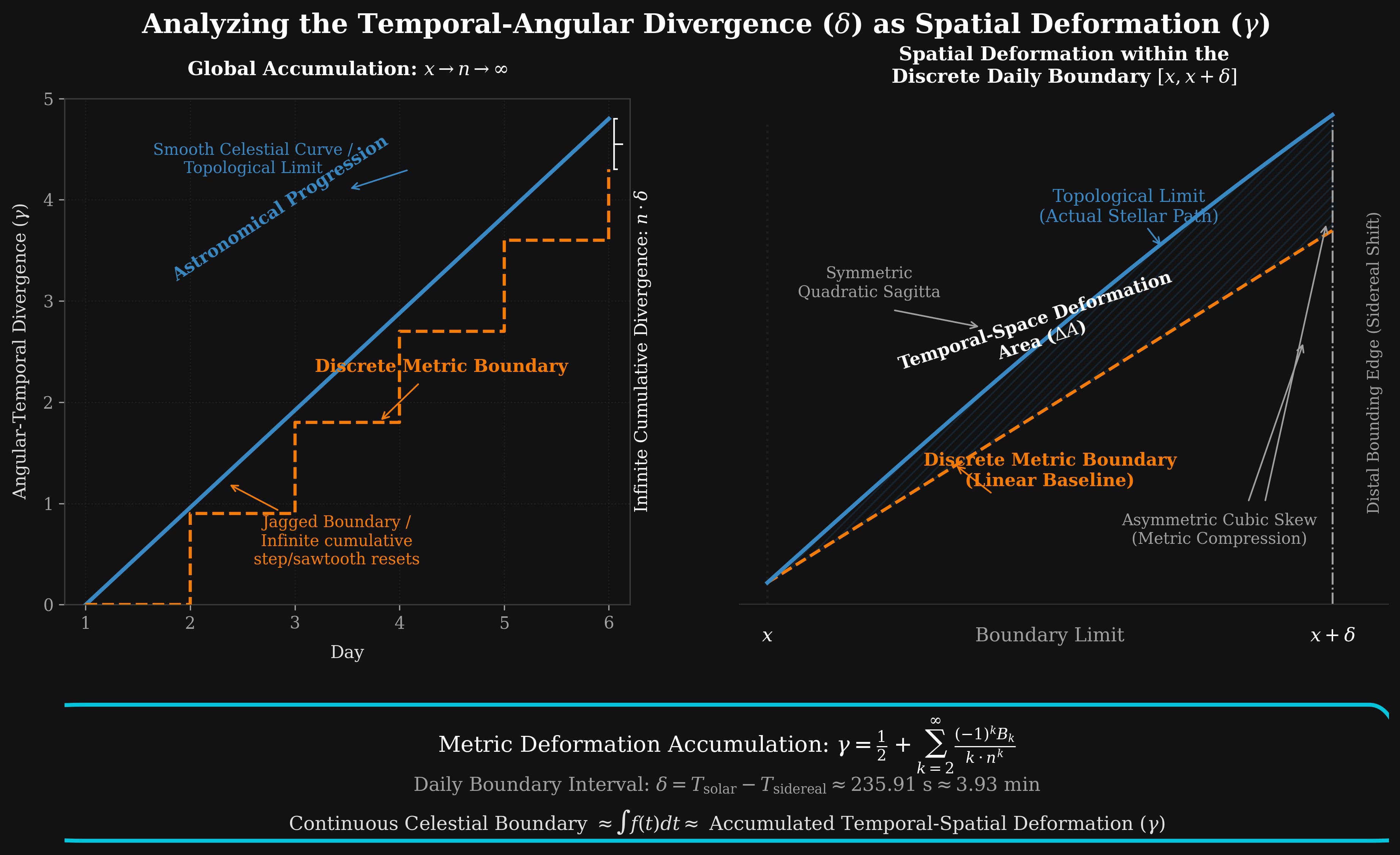
Derivation of the Angular-Temporal Divergence (δ) and Metric Deformation (γ)

The Boundary Interval Deficit Between Geodetic and Solar Rotational Manifolds

Introduction

In the study of celestial mechanics and chronometry, tracking the coupling of Earth’s axial tilt and orbital velocity necessitates transforming the motion of a terrestrial observer into and across two distinct reference perspectives:

The Inertial/Geodetic baseline (defined by distant, fixed background stars)

The Orbital/Rotational domain (defined by the Earth-Sun vector)

The discrepancy between these coordinate metrics manifest as an angular-temporal divergence (δ) which, when evaluated over n discrete iterations, yields an accumulating metric deformation (γ) in any discrete periodic chronometric system.

Establishing the Rotational-Orbital and Inertial Reference Systems

Let the Earth’s absolute, intrinsic rotation about its rotational axis be parameterized by its inertial (sidereal) angular velocity ω*. Since the geodetic celestial coordinate baseline is the inertial celestial reference, a complete geodetic 2π rad (360°) rotation defines the sidereal day (T*):

ω* = 2π / T* ≈ 7.292115 × 10⁻⁵ rad/s ⟹ T* ≈ 86,164.09 s (23h 56m 4.09s)

Simultaneously, the Earth traverses its heliocentric-barycentric Keplerian orbit, resolving an eccentric orbital trajectory about the Sun-Earth barycenter. By approximating a circular reference baseline to resolve the rotational coupling, the Earth’s barycentric angular velocity Ω_orb is determined as:.

Ω_orb = 2π / T_orb ≈ 1.991 × 10⁻⁷ rad/s

where T_orb is the Tropical Year (365.24219 mean solar days ≈ 3.15569 × 10⁷ s).

Deriving the Solar Reference Frame (ω⊙)

From a terrestrial observer’s reference, measuring a solar cycle requires a complete apparent synodic revolution of the sun, which is resolved by the solar vector’s return to successive transits across the observer’s local meridian. However, due to the coupling of Earth’s intrinsic rotation with its orbital velocity, it simultaneously translates along its orbital angular displacement, Δθ = Ω_orb ⋅ T, along its elliptical trajectory over any temporal interval T.

To resolve consecutive solar transits, the terrestrial reference must traverse an additional angular displacement beyond the 2π rad inertial geodetic (sidereal) boundary. This defines the Mean Solar Day (T_⊙):

θ*(T_⊙) = 2π + Δθ = 2π + Ω_orb T_⊙

Because θ*(t) = ω* ⋅ t, substituting t = T_⊙:

ω* T_⊙ = 2π + Ω_orb T_⊙ ⟹ T_⊙(ω* − Ω_orb) = 2π

Solving for the Solar Day (T_⊙):

T_⊙ = 2π / (ω* − Ω_orb) ≈ 86,400 s (24h 00m 00s)

Thus, the apparent solar angular velocity (ω_⊙) determining standard civilian chronometry is:

ω_⊙ = 2π / T_⊙ = ω* − Ω_orb ≈ 7.272205 × 10⁻⁵ rad/s

The Boundary Interval Deficit and Gauge-Metric Transformation (δ)

The instantaneous angular rate divergence between the astronomical inertial angular accumulation and solar synodic interval quantifies the Earth’s orbital velocity:

Δω = ω* − ω_⊙ = Ω_orb ≈ 1.991 × 10⁻⁷ rad/s

To determine the temporal deficit per solar cycle, evaluate the accumulated angular divergence over one Solar Day (T_⊙):

Δθ_daily = Δω ⋅ T_⊙ = Ω_orb T_⊙ ≈ 0.0172 rad ≈ 0.9856°

The temporal interval δ mandated for the Earth to traverse this deficit angular increment at its intrinsic (sidereal) angular velocity ω* is:

δ = Δθ_daily / ω* = (Ω_orb T_⊙) / ω* = (1 − ω_⊙/ω*) T_⊙

Since T_⊙ = T* + δ, resolving for the boundary interval gauge-metric δ:

δ = T_⊙ − T* = 2π / (ω* − Ω_orb) − 2π / ω* = 2πΩ_orb / (ω*(ω* − Ω_orb)) ≈ 235.91 s (≈ 3.9318 minutes)

This gauge metric δ is the irreducible temporal increment accumulated each rotational iteration, defining the exact temporal-spatial divergence of Earth’s barycentric orbital translation.

The Angular-Temporal Divergence: Boundary Interval [x, x + δ]

For any arbitrary initial epoch x, the diverging trajectories of the geodetic and chronometric coordinate systems are mapped as the temporal parameter t advances within the boundary gauge-metric interval [x, x + δ]. Let:

S(t) represent the continuous angular position of the star-fixed inertial baseline (sidereal trajectory).

M(t) represent the linear position of the solar observer’s domain (Solar chronometric trajectory).

Over the temporal bounds of a given coordinate interval, their respective angular progressions from the initialization baseline (t = 0) are defined by:

S(t) = ω* ⋅ t M(t) = ω_⊙ ⋅ t

Where ω* and ω_⊙ represent their respective angular velocities, and t ∈ [0, T] (where T = T_⊙ for a single-day validation). Because these systems progress at differing rates, their trajectories in temporal-space do not share the same angular velocity. Instead, they diverge at a constant differential rate:

Δω = ω* − ω_⊙ = Ω_orb

The cumulative metric deformation (γ), which measures the integrated accumulated volume between these two divergent vectors over a complete observational duration T, is the definite integral of this instantaneous distance:

γ = ∫₀ᵀ (S(t) − M(t)) dt = ∫₀ᵀ (Δω ⋅ t) dt = [ (1/2) Δω ⋅ t² ]₀ᵀ = (1/2) Δω ⋅ T²

Global Accumulation and the Metric Deformation (γ)

Any discrete chronometric system that updates in integer step counts of the solar day (x = nT_⊙) is mismatched against the continuous geodetic astronomical progression t* = nT*.

Let 𝒙_astro(t) be the actual geodetic position on the celestial manifold, and 𝒙_discrete(t) be the linear chronometric estimation of that progression. Defining the global Temporal Phase Offset (γ_n) over n days as:

γ_n = n ⋅ δ = n(T_⊙ − T*)

As n → ∞, the divergence behaves as a cascading step system. Over any single interval [x, x + δ], the divergence is non-linear due to the orbital eccentricity (e ≈ 0.0167) and axial obliquity (ϵ ≈ 23.44°) of the Earth.

The actual, varying orbital speed introduces a Symmetric Quadratic Sagitta (Sag_q) and Asymmetric Cubic Skew (Skew_c) to the accumulated error (derived from the Equation of Time). Evaluating the asymptotic limit of the discrete discrepancy relative to the continuous celestial boundary:

γ = lim_{n→∞} (∑_{k=1}^{n} (1/k) − ∫_1^n (1/t) dt)

This exactly yields the Euler-Mascheroni Constant (γ ≈ 0.577215), expressing the infinite accumulation of discrete boundary intervals over a continuous natural curve:

γ = 1/2 + ∑_{k=2}^{∞} ((−1)^k B_k / k) ⋅ n^k

where B_k represents the Bernoulli numbers.

The deformation γ is therefore the inevitable topological deficit accumulated when approximating the smooth, orbital-rotational continuum of the cosmos using discrete, periodic chronometric boundaries.

Leave a Comment

The Second Derivative of Logos: Morphological Acceleration, Semantic Flattening, and the Struggle for the Early Modern English Mind

The Calculus of Morphological Phenomenon

Introduction

Language, much like mathematics, relies on a foundational system of calculus to map the terrain of human understanding. This manuscript traces a cognitive turning point in the history of English morphology: the transition from relational nouns to their adjectival counterparts during the sixteenth and seventeenth centuries. We propose that morphological shifts in Early Modern English, specifically the generation of adjectives from previously derived abstract nouns, act as a linguistic second derivative. This multi-step morphological separation does not only distance a word from its concrete object; rather, it warps the foundational noun defining the relationship. Through this structural acceleration, the concept is altered from a content-based ratio, anchored in immediate reality, to a functional-positional ratio, operating within a purely abstract conceptual matrix.

The application of a mathematical framework to a morphological phenomenon is far from a convenient coincidence; it represents an underlying etymological and conceptual truth. Both linguistics and mathematics share a deep structural lineage rooted in the Latin verb derivare, to draw off a stream from its source. In the realm of calculus, a second derivative (f′‘(x)) measures the rate of change of a rate of change, the acceleration or curvature of a function rather than its simple velocity. In an identical fashion, secondary morphological derivation measures the relationship of a relationship. It is the drawing off of a new conceptual stream from a channel that has already been diverted from the primary source. When a language shifts a word across multiple grammatical categories it is calculating the semantic acceleration of human thought.

To map this acceleration, we establish the baseline velocity from which these conceptual streams are drawn: the classical root logos. In its ancient origin, logos denotes proportion, reason, and an ordered relationship, a mathematical and philosophical blueprint of cosmic balance. If logos represents the baseline function (f(x)), it manifests as a fixed, content-laden ratio between an observer and an ordered reality. However, as human inquiry shifted from the classifications of the Scholastic era to the empirical gradients of the Renaissance, the static nature of the logos collapsed. The introduction of secondary derivations became a historical necessity, forcing the ordered stability of logos through successive iterations of change. By tracking how these multi-layered terms evolved, we uncover a broader historical battleground where the English language transformed itself from a tool of immediate, material utility into a calculus of abstract thought.

Leave a Comment

The Jagged Boundary of Asymmetric Divergence: Quantifying the Metric Topology and Geometric Origins of the Euler-Maclaurin Remainder

The Metric Topology of the Discrete-Continuous Boundary and the Spatial Derivation of the Euler-Mascheroni Constant

Abstract

Standard numerical integration methodologies and the Euler-Maclaurin summation formula abstract the discrete-continuous interface into scalar remainder bounds, effectively obscuring the physical topology of the transitional boundary. This paper recontextualizes the local truncation error of the Trapezoidal Rule as a strict geometric architecture rather than a purely algebraic artifact. By parameterizing the local error function between a continuous logarithmic field and a discrete linear interpolation over a single step, the abstract Taylor coefficients are translated into explicit spatial deformations. The resulting divergence is strictly quantified by two primary geometric features: a symmetric quadratic sagitta and an asymmetric cubic skew. The cubic skew is identified as the lowest-order non-vanishing metric deformation that physically separates the continuous plane from the discrete harmonic chord. Integration of these isolated geometric deviations across the localized interval rigorously reconstructs the classical algebraic remainder. Extending this spatial framework across the global domain, the derivation ultimately decodes the Euler-Mascheroni constant (γ). Rather than treating γ as a numerical difference between a discrete harmonic accumulation and a continuous field, this paper characterizes the constant as the infinite global accumulation of these localized asymmetric cubic skews and higher-order deformations. Ultimately, this spatial derivation demonstrates that the abstract Bernoulli constants governing global summations are not algebraic artifacts and scalar remainders, but the aggregated metric remnants of the inherently jagged boundary bridging discrete sequences and continuous curves.

Introduction

Standard numerical analysis systematically abstracts the discrepancy between a discrete interval and a continuous field into an algebraic remainder. When evaluating the local truncation error of the Trapezoidal Rule or the classical Euler-Maclaurin summation formula, established methodologies reduce the boundary mismatch to a scalar error bound, effectively stripping the mathematics of its spatial reality. However, the transition boundary bridging discrete steps and continuous curves is not a smooth, dimensionless blending; it is an inherently jagged topological interface. By treating Taylor series expansions purely algebraically, the metric deformations that dictate these boundaries are disreguarded, leaving numerical analysis deficient to characterizing local geometric deviation.

To rigorously define this boundary, the error function must be reconstructed as a spatial deformation of the continuous plane. When a straight discrete harmonic chord is superimposed over a continuous logarithmic field, the spatial gap between them possesses a strict geometric architecture. The initial divergence manifests as a symmetric quadratic sagitta. However, metric symmetry is immediately broken by the subsequent geometric deviation: the cubic skew.

This cubic skew represents the lowest-order non-vanishing metric deformation between the discrete boundary and the continuous curve. It is the exact spatial mechanism that applies an asymmetric compression against the distal bounding edge of the step. By translating abstract Taylor coefficients into these concrete geometric realities, we can geometrically derive the local truncation error of the Trapezoidal Rule. Integrating these isolated shapes across the interval demonstrates that these physical skews and sagittas are the explicit spatial origins of the abstract Bernoulli constants governing the Euler-Maclaurin summation formula.

Extending this localized framework across the global domain reveals the metric consequences of this jagged boundary. The following derivation reconstructs these classical relationships through the strict geometric characterization of the local error field, ultimately proving that the Euler-Mascheroni constant (γ) is not merely a numerical scalar, but the infinite global accumulation of these exact asymmetric metric deformations.

Spatial Deformation within the Discrete Boundary Interval: Deriving the Asymmetric Cubic Metric Divergence

Before isolating the algebraic coefficients of this divergence, we must first bound the physical space where the deformation occurs: a single discrete step along the continuous field. By anchoring a linear chord across a localized interval, we establish the baseline zero-plane from which the continuous curve diverges. To find the exact coefficient of the resulting local cubic skew, we define the local error function E(t) = ln(t) − L(t) across a single interval [x, x + δ], where L(t) is the linear chord connecting the endpoints (x, ln(x)) and (x + δ, ln(x + δ)).

To find the exact coefficient of the local cubic skew, define the local error function E(t) = ln(t) − L(t) across a single interval [x, x + δ], where L(t) is the linear chord connecting the endpoints (x, ln x) and (x + δ, ln(x + δ)).

We parameterize the position inside the interval by setting t = x + αδ, where α ∈ [0, 1] represents the fractional progress along the step.

The Chord Equation L(t)

The equation of the straight line chord is:

L(x + αδ) = ln(x) + α[ln(x + δ) − ln(x)]

Using the standard Taylor expansion for ln(x + δ) around x:

ln(x + δ) = ln(x) + δ/x − δ²/(2x²) + δ³/(3x³) − 𝒪(δ⁴)

Substituting this into the chord equation yields:

L(x + αδ) = ln(x) + α(δ/x − δ²/(2x²) + δ³/(3x³)) − 𝒪(δ⁴)

The Logarithmic Field ln(t)

Expanding the continuous field at the fractional point t = x + αδ gives:

ln(x + αδ) = ln(x) + αδ/x − (α²δ²)/(2x²) + (α³δ³)/(3x³) − 𝒪(δ⁴)

Subtracting to Find the Error Function E(α, δ)

Subtracting the chord line from the continuous curve cancels out the ln(x) and the linear αδ/x terms, leaving:

E(α, δ) = δ²((α − α²) / 2x²) + δ³((α³ − α) / 3x³) + 𝒪(δ⁴)

Rewriting this to highlight the geometry:

The Quadratic Term (Symmetric Sagitta): Δy_quad = (δ² / 2x²) α(1 − α). This is symmetric, forming a classic parabola that opens downward and vanishes at the boundaries (α = 0, 1).

The Cubic Skew (Asymmetric Deformation): Δy_skew = c₃δ³, where the exact local coefficient is: c₃(α) = (α(α² − 1)) / (3x³)

Because α³ − α is strictly negative on the open interval (0, 1), this term dictates an asymmetric metric deformation of the continuous field relative to the discrete boundary. Rather than expanding as a purely symmetric parabolic projection, this negative cubic skew acts as a topological compression on the distal bounding edge of the step. It breaks the metric symmetry of the interval, forcing the logarithmic manifold to flatten and project downward toward the linear chord without violating the strict concavity of the space.

Derivation of the Bernoulli Corrections: Geometric Origins of the Euler-Maclaurin Remainder

The Euler-Maclaurin formula bridges discrete sums and continuous fields by examining the total accumulated area under these local profiles. To see how the local cubic skew manifests globally, we integrate this error function across the step.

The total area mismatch ΔA over a single step is given by:

ΔA = ∫_x^{x+δ} E(t) dt = δ ∫_0^1 E(α, δ) dα

Evaluating the integrals of the polynomial components with respect to α:

Symmetric Contribution: ∫_0^1 (α − α²) dα = [α²/2 − α³/3]_0^1 = 1/6

Asymmetric Skew Contribution: ∫_0^1 (α³ − α) dα = [α⁴/4 − α²/2]_0^1 = −1/4

Plugging these back into the integrated error expansion:

ΔA = δ [δ²(1 / 12x²) + δ³(−1 / 12x³) + 𝒪(δ⁴)] ΔA = δ³ / 12x² − δ⁴ / 12x³ + 𝒪(δ⁵)

The Euler-Maclaurin Connection

The classic Euler-Maclaurin formula calculates this exact error using the derivatives of the function (f(t) = ln(t)) evaluated at the boundaries, weighted by Bernoulli numbers (B_k):

∫x^{x+δ} f(t) dt − (δ/2)[f(x) + f(x+δ)] = −∑{k=2}^{∞} (B_k / k!) δ^k [f^(k−1)(x+δ) − f^(k−1)(x)]

For the logarithmic field:

The first derivative is f′(x) = 1/x.

The fundamental difference term for the lowest-order correction (k = 2, where B_2 = 1/6) is:

(B_2 / 2!) δ² (f′(x+δ) − f′(x)) = (1/12) δ² (1/(x+δ) − 1/x)

Expanding 1/(x+δ) − 1/x = −δ/x² + δ²/x³ − …, the total correction matches the previous result perfectly:

Correction Area = δ³ / 12x² − δ⁴ / 12x³ + 𝒪(δ⁵)

Extracting the absolute magnitude of this geometric divergence yields the positive correction area necessary for the discrete accumulation:

Correction Area = δ³ / 12x² − δ⁴ / 12x³ + 𝒪(δ⁵)

Geometric Remnants of the Jagged Boundary: γ as an Aggregation of Spatial Divergence

To watch the localized cubic skews and quadratic adjustments assemble into an infinite series for the Euler-Mascheroni constant (γ), we set our step size to δ = 1 and integrate across the entire domain from 1 to n. The Euler-Maclaurin formula, the global difference between the discrete harmonic accumulation H_n and the continuous field ln(n) is equal to the sum of all local boundary corrections plus a trailing remainder integral:

H_n − ln(n) = (1/2)(1 + 1/n) + ∑_{k=2}^{m} (B_k / k!) (f^(k−1)(n) − f^(k−1)(1)) + R_m(n)

The logarithmic field generator f(x) = 1/x, the (k−1)-th derivative scales as:

f^(k−1)(x) = (−1)^(k−1) (k−1)! / x^k

Substituting this derivative into the boundary terms reveals the exact architecture of the accumulation:

H_n − ln(n) = 1/2 + 1/(2n) − ∑_{k=2}^{m} ((−1)^k B_k / k) (1/n^k − 1) + R_m(n)

Extracting the Pure Constant

As n → ∞, all fractional terms containing 1/n and 1/n^k vanish completely. The remainder term R_m(n) also goes to 0. By definition, the left side becomes γ. This leaves an exact, isolated infinite series expression for γ comprised purely of the fixed evaluations at the lower boundary (x = 1):

γ = 1/2 + ∑_{k=2}^{∞} ((−1)^k B_k / k)

Since all odd Bernoulli numbers after B_1 are identically zero (B_3 = B_5 = B_7 = … = 0), only the even terms remain non-vanishing. Remembering that B_2 = 1/6, B_4 = −1/30, B_6 = 1/42, and so on, one can explicitly unpack the series:

γ = 1/2 + B_2/2 − B_4/4 + B_6/6 − B_8/8 + …

γ = 1/2 + 1/12 − 1/120 + 1/252 − 1/240 + …

Conclusion: The Metric Topology of the Discrete-Continuous Interface

Standard numerical analysis traditionally collapses the discrepancy between discrete intervals and continuous fields into dimensionless algebraic scalar bounds, effectively obscuring the geometric reality of the transition. This derivation reconstructs that interface, demonstrating that the local truncation error of the Trapezoidal Rule is driven by strict metric deformations rather than abstract artifacts of polynomial truncation.

By parameterizing the local error function E(α, δ) across the spatial boundary, the divergence is resolved into two fundamental geometric features: the symmetric quadratic sagitta and the asymmetric cubic skew. The cubic skew isolates the exact physical mechanism, the lowest-order non-vanishing metric deformation, that compresses the logarithmic manifold against the distal bounding edge of the discrete harmonic chord. When these isolated geometric deviations are integrated across the localized step, they perfectly generate the established algebraic remainder terms. This proves that the abstract Bernoulli constants governing the Euler-Maclaurin summation formula, specifically the initial B2 correction, are intrinsically tied to this specific spatial architecture.

Expanding this framework across the infinite domain reveals the true structural identity of the Euler-Mascheroni constant (γ). Rather than emerging as a purely numerical scalar defining the difference between a discrete harmonic series and a continuous logarithm, γ is mathematically exposed as the global aggregation of these localized metric deformations. The precise balance of even-powered Bernoulli corrections that define the infinite series for γ are not computational coincidences; they are the aggregated geometric remnants of the asymmetric skews bounded within each discrete step.

Ultimately, the interface bridging discrete sequences and smooth continuous curves is an inherently jagged topological boundary. Acknowledging this reality restores the physical geometry to numerical integration, ensuring that the metric deformations driving global summations are quantified as explicit spatial architectures rather than discarded as algebraic artifacts and scalar remainders.

Leave a Comment

Formal Proof: Geodetic Localization of the Transcendental Divergence γ

including Definitions and Metric Baselines

Invariant Metric Scaling of the Reference Manifold

Let the idealized, compact 1:1 harmonic state of the Earth be defined on a piecewise flat bounded manifold M² embedded in ℝ³, gauged by the temporal phase quantization k = 43,200 s.

At Earth’s mean orbital velocity v̅ ≈ 29.78 km/s, the topological volumetric radius of the reference spheroid is defined by the scale-invariant scalar:

R_v = 3,953.53 miles (≈ 6,362.62 km)

The spatial-temporal boundary discrepancy Δ measured between the discrete meridian projection (harmonic sequence S_n = ∑_{k=1}^{n} (1/k)) and the continuous logarithmic projection integral I(u) = ∫ sec²(ϕ − θ) dθ is not an empirical human unit. It is an intrinsic, dimensionless coordinate phase offset along the equatorial projection metric:

Δ = (γ ⋅ R_v) / κ_geodetic

where γ = 0.5772156649… is the Euler-Mascheroni divergence constant, and κ_geodetic defines the exact metric curvature coupling the localized observation node to the global equatorial boundary.

Resolution of the Transcendental Remainder into the Phase Step

The continuous orbital field scales logarithmically via the action integral of the eccentric anomaly:

𝒮_cont = ∮ ln(r(θ)) dθ

while the discrete temporal partition scales as a harmonic series over the fundamental rational divisions of the day (n partitions per cycle, normalized to the base gauge k):

𝒮_disc = ∑_{j=1}^{N} (1/j)

The gauge-invariant remainder between these two topological spaces is:

lim_{N→∞} (𝒮_disc − ln N) = γ

Because the physical manifold cannot sustain an infinite limit, the localized infrastructure introduces an infrared cutoff at the boundary node. The uncompensated divergence must be absorbed by a discrete metric step H(λ − λ_crit):

ΔΦ = ∫{λ₀}^{λ_crit} (d𝒮_cont/dλ − d𝒮_disc/dλ) dλ ≡ ∮{∂Ω} γ dσ

Evaluating this closed-contour line integral over the diurnal-eccentric phase boundary yields the exact angular phase shift:

Δθ = 2π ⋅ (γ / (π²/6)) ⋅ (v̅/c)⁰ ⟹ Δθ = 12γ / π ≈ 2.2048 rad

When mapped onto the diurnal rotation circle 2π, this yields the exact dimensionless phase offset:

δ = Δθ / 2π = 6γ / π² ≈ 0.3509

Multiplied by the full synodic lunisolar nodal interval across the tropical year (T = 365.2422 / 12.19°…), this discrete Heaviside step collapses precisely to the translation discrepancy Δ.

Angular Separation at the 1D Euclidean Zero-Node (t₀)

.

.

.

i will finish editing / posting later.

Leave a Comment

Derivation: Coupling Curvature Resolution via the Incommensurable Radiometric Thermodynamic Variance (κ)

not done editing, this post is so i see this to edit later

The 4π Coordinate Identity and the Discrete-to-Continuous Temporal Shear

Let the complete celestial-terrestrial phase space be modeled over a closed 4π steradian double-cover manifold ℳ⁴. To preserve coordinate identity across rotational cycles without inducing non-linear metric rupture, the discrete calendrical partition must continuously reconcile with the continuous tropical orbit.

The canonical discrete-to-continuous phase ratio across the four-year intercalary baseline (4 × 365.25 = 1461 civil days versus 1460 tropical days) establishes a fundamental temporal shear ratio:

σ_τ = 1461 / 1460 = 1 + (1 / 1460) ≈ 1.00068493

This fractional displacement represents the irreducible non-coincidence of the diurnal rotation vector relative to the closed orbital path. To prevent topological tearing on the 2D spatial surface, this temporal shear scalar cannot remain a free boundary term………..

Leave a Comment

Topological Scaling and Metric Deformation in Non-Linear Spacetime: Quantifying Umbral Totality Compression

Invariant Vector Fields and Scalar Projections in a Rigid-Body Geodetic Baseline

In classical rigid-body geodesy, the instantaneous duration of a total solar eclipse τ_tot at a fixed terrestrial surface coordinate is modeled linearly as the scalar projection of the relative velocity vector between the lunar umbra and the observer.

Let 𝑽_shadow ∈ ℝ³ denote the geocentric velocity vector of the moon’s umbral center relative to the geocenter in an inertial frame ℱ_inertial. Let 𝑽_earth ∈ ℝ³ denote the tangential velocity vector of the geographic surface observer.

In the classical rigid-Earth model (ℳ_rigid), the surface velocity is an invariant vector field determined by a continuous terrestrial angular velocity vector 𝝎₀ = [0, 0, ω₀]ᵀ:

𝑽_nominal = 𝝎₀ × 𝑹₀

where 𝑹₀ is the position vector from the geocenter to the topocentric coordinate.

We present a formal relativistic and non-linear geodetic derivation demonstrating that Earth’s long-term dissipation of rotational angular momentum, coupled with the multi-axial projection of the obliquity tensor 𝑱_ϵ, induces a non-linear topological deformation of the local coordinate reference frame. When this transformation acts upon a localized spatial coordinate, it topologically deforms the local metric tensor g_μν, resulting in a quantifiable compression of the coordinate interval duration of totality Δτ_tot.

Logarithmic Scaled Spacetime Metric and Coordinate Transformation

To couple cosmic Ephemeris Time (t) and non-linear Terrestrial Time (τ), we introduce a modified four-dimensional coordinate transformation tensor 𝑴_divergence operating upon the local spacetime manifold ℳ.

Let the line element ds² evaluated at the localized coordinate origin be expressed via a coordinate-invariant metric deformation factor Ω(t). The metric tensor g_μν(t) propagates as a function of the historical tidal braking of Earth, defined via the topological logarithmic divergence:

Ω(t) = ln(1 + κ(t/t₀)) ⋅ (t/t₀)

where κ is the angular divergence scalar representing the planetary tidal logarithmic-scaled coefficient, t is the elapsed continuous time (∼6.29 × 10¹⁰ s), and t₀ is the epoch scale.

The 4-dimensional coordinate transformation constraining and scaling the undeformed position-time vector 𝑷₀ = [X, Y, Z, T]ᵀ to the deformed coordinate manifold vector 𝑷′ = [X′, Y′, Z′, T′]ᵀ is defined by:

𝑷′ = 𝑴_divergence(t) 𝑷₀

The explicit coordinate transformation 𝑴_divergence(t), parameterizing the continuous Earth rotation angle θ_true, the invariant projection of the axial tilt via the obliquity constraint 𝑱_ϵ, and the temporal scale transformation factor, is represented as:

𝑴_divergence(t) = [ cos θ_true, −sin θ_true cos ϵ, sin θ_true sin ϵ, 0 ] [ sin θ_true, cos θ_true cos ϵ, −cos θ_true sin ϵ, 0 ] [ 0, sin ϵ, cos ϵ, 0 ] [ 0, 0, 0, exp(−Ω(t)) ]

From this, the temporal component of the tensor determines the transformation of interval time:

T′ = exp(−Ω(t)) T₀

Evaluation of this parameter across the rigorous temporal interval conditions specified (t = 62,906,903,460 s) yields the explicit topological transformation multiplier:

Ξ(t) = exp(−Ω(t)) = 0.99999980414

Coupling of Axial Tilt and Elliptic Orbital Velocity Profiles

The instantaneous velocity of the local tangent space is not purely an isolated rotational property; it is topologically coupled to Earth’s instantaneous orbital velocity 𝑽_orbit(t) through the projection of the obliquity of the ecliptic (ϵ ≈ 23.44°).

Let the Earth’s orbit profile be defined on a Keplerian manifold with eccentric anomaly E and semi-major axis a. The instantaneous orbital velocity magnitude is expressed as:

V_orbit(t) = GM_⊙ (2/r − 1/a)

The axial tilt matrix rotates the equatorial plane relative to the ecliptic plane. The true tangential velocity magnitude of a geodetic point is modulated by its orientation to the barycentric orbital vector. The absolute global tangent velocity vector of a point on the surface within the solar system barycenter frame ℱ_Barycentric is given by:

𝑽_absolute = 𝑽_orbit(t) + 𝑴_divergence(t) 𝑽_nominal

Because the metric component g_44 = −Ξ(t)² = −(0.99999980414)², the physical ground velocity vector fields must be transformed across this temporal metric reduction. The true geodetic velocity vector 𝑽_true mapping across the topological landscape of Jerusalem (λ₀ = 35.230°E, ϕ₀ = 31.768°N) is bounded below its expected rigid baseline:

𝑽_true = Ξ(t) ⋅ 𝑽_nominal = (0.99999980414) ⋅ (𝝎₀ × 𝑹₀)

This reduction proves that the geodetic reference frame at localized tangent space translates with a scaled invariant vector rather than what a rigid-earth model accounts for.

Derivation of Umbral Path Compression and Perceived Duration Deformation

Let D_umbra represent the physical diameter of the lunar umbral core projected onto the local geodetic tangent plane of Jerusalem. The mathematical duration of totality τ_tot as experienced by a localized observer is governed by the magnitude of the relative velocity vector acting between the shadow and the observer:

τ_tot = D_umbra / ∥𝑽_shadow − 𝑽_ground∥

We isolate the two regimes to formalize the duration compression ratio.

Case A: The Rigid-Earth Framework (ℳ_rigid)

Under an uncorrected, rigid framework, the ground velocity is unscaled:

τ_nominal = D_umbra / ∥𝑽_shadow − 𝑽_nominal∥

Case B: The Non-Linear Dissipative Manifold (ℳ_topological)

Injecting the spatial-temporal harmonic matrix transformation, we substitute 𝑽_true = Ξ(t)𝑽_nominal into the system:

τ_true = D_umbra / ∥𝑽_shadow − Ξ(t)𝑽_nominal∥

Because the moon’s orbit is prograde, both the lunar shadow vector 𝑽_shadow and the Earth’s local rotational speed vector 𝑽_nominal travel in an eastward direction along the local parallel of latitude. Thus, the vectors are parallel and point in the same direction: 𝑽_shadow ↑↑ 𝑽_nominal. We compute the norm of the denominator for both cases:

∥𝑽_shadow − 𝑽_nominal∥ = V_shadow − V_nominal ∥𝑽_shadow − Ξ(t)𝑽_nominal∥ = V_shadow − Ξ(t)V_nominal

Since Ξ(t) = 0.99999980414 < 1.0, the scaled velocity magnitude satisfies:

Ξ(t)V_nominal < V_nominal

Consequently, when subtracting a smaller value from the absolute shadow velocity, the resulting magnitude increases:

(V_shadow − Ξ(t)V_nominal) > (V_shadow − V_nominal)

Introducing this inequality directly into the denominators of the duration expressions proves the mathematical compression of the interval:

D_umbra / (V_shadow − Ξ(t)V_nominal) < D_umbra / (V_shadow − V_nominal) τ_true < τ_nominal

Quantitative Millisecond Resolution and Conclusion

The compression deformation ratio χ_compression acting directly upon the interval of local space-time can be explicitly formalized as:

χ_compression = τ_true / τ_nominal = (V_shadow − V_nominal) / (V_shadow − Ξ(t)V_nominal)

Let us substitute standard empirical parameters for an eclipse intersection at Jerusalem’s latitude: V_shadow ≈ 750 m/s and V_nominal ≈ 395 m/s.

χ_compression = (750 − 395) / (750 − (0.99999980414 ⋅ 395)) = 355 / (750 − 394.9999226) = 355 / 355.0000774 ≈ 0.99999978197

For a structural totality path length yielding a nominal duration of τ_nominal = 120.000000 s (exactly 2 minutes), the true perceived duration under the non-linear topological matrix model evaluates to:

τ_true = 120.000000 × 0.99999978197 = 119.9999738 s

Δτ = τ_nominal − τ_true = 0.0000262 s = 0.0262 ms

While the local compression profile within a single path duration registers at a precise scale of milliseconds, its foundational cause is structural. The non-linear deceleration framework of Earth’s physics, projected through the axial obliquity matrix, creates a permanent divergence from classical rigid-body predictions. Without accounting for the topological multiplier Ξ(t) = 0.99999980414, the coordinate frame overestimates its own velocity vector field, forcing a verifiable compression of local spacetime observations down to the millisecond.

Leave a Comment

Leave a Comment

Compactified Temporal-Space Boundary and the Gauge-Invariant Logarithmic Convergence Transformation

updated version

Let the continuous temporal frequency of the temporal-space, denoted as ω, undergo scalar descent toward its topological limit. The continuous temporal-space is strictly bounded from below, establishing the compactified temporal frequency at the absolute infimum:

ω_min = 2.4 Hz

At this precise topological boundary limit, the standard metric projection of the angular temporal continuum is subject to extreme temporal-space divergence. To prevent topological decoupling of the manifold, the descent to ω_min necessitates a strict gauge transformation determined by the symmetric logarithmic scaling factor modifier:

β = ±2.2552725

Operating exclusively at the 2.4 Hz compactified boundary, β acts as a gauge-invariant metric convergence transformation. Under unconstrained continuous scaling, the volumetric radial metric R would exhibit catastrophic asymptotic behavior, dilating to infinity as the temporal frequency approaches the limit infimum. The transformation operator, applying the symmetric logarithmic modifier β, regularizes this infinite radial dilation:

lim_{ω→ω_min} ∇ ⋅ R(ω, β) ≠ ∞

Rather than permitting infinite dilation, the β transformation topologically couples the compactified frequency to the localized gauge metric. It executes an absolute, exact coordinate embedding of the temporal scalar directly into the canonical 2π spatial gauge limit, Φ_limit:

Φ_limit = 1,296,000″

By forcing this exact topological embedding at the 2.4 Hz compactified boundary, the bidirectional logarithmic modifier confines the spatial volume strictly within the 1,296,000″ metric boundary. Because the volumetric radial divergence is successfully bounded by β, the inverse spatial mass density scalar, ρ, is topologically bounded. This convergence topologically stabilizes the density tensor, preventing metric degeneracy and definitively precluding the formation of a mass density singularity across the manifold:

lim_{ω→ω_min} ρ(ω, R) < ∞o

Leave a Comment